
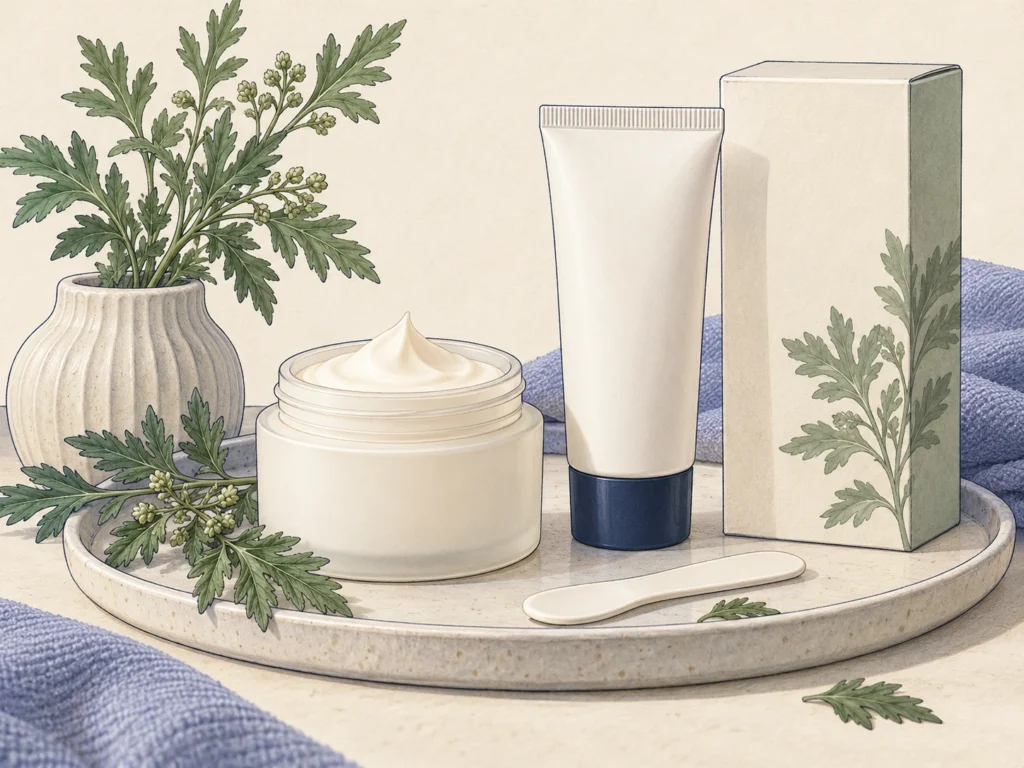
Mugwort cream is a finished skincare formulation containing a mugwort-derived ingredient. Compare its intended purpose, full ingredient list, texture, directions and packaging. The botanical name does not make every cream equivalent, and a rich-looking texture does not by itself establish a better moisturizer.
One mugwort cream may be a lightweight gel-cream, while another may be a richer moisturizer. Both can feature mugwort, yet feel different and contain different supporting ingredients.
This guide explains how to compare those products and what an overseas retailer or small brand should confirm before exploring private label manufacturing.
What is mugwort cream?
It is a cosmetic cream formulated with a mugwort-derived ingredient among the components that make up the finished product. Check the exact botanical ingredient and the full formulation information rather than judging it by a leaf image or a short product name.
Many moisturizing creams use a formulation combining water, oils and other ingredients. The complete system contributes to texture, preservation and product performance. Mugwort is not a complete explanation of how the cream works.
A mugwort essential oil, raw extract or jar of plant powder is not equivalent to a finished cream. A finished product requires an appropriate formulation and assessment, not simply adding a botanical ingredient to a base without review.
Cream, lotion or gel-cream: what should you compare?
| Description | What to compare | Useful question |
|---|---|---|
| Mugwort cream | Richness, spreadability, finish and complete formula | Does the actual texture suit the intended customer and use? |
| Mugwort gel-cream | Texture, dispensing and the finish after application | What does this supplier mean by “gel-cream”? |
| Mugwort lotion | Fluidity, pack format and intended face or body application | Are the product scope and directions the same as the cream being compared? |
| Other mugwort skincare | Essence, toner or mask formulation and purpose | Is this a different product step rather than an alternative moisturizer? |
These descriptions are not a universal quality ranking. A thicker product is not automatically better, and a lighter product is not automatically less useful. Compare the actual formula and product experience.
Which ingredients deserve attention?
Start with the current complete ingredient list. Look at the botanical ingredient alongside the other components, including those relevant to moisturizing, texture, fragrance and preservation.
If a particular ingredient causes concern for you, check the actual list rather than relying on “natural,” “clean” or “gentle” on the front label. A botanical product can still be unsuitable for an individual user.
For a brand project, request the formulation information needed by the responsible reviewer. Ask what any mugwort percentage refers to and how it is calculated. A large extract percentage does not, on its own, show that the cream will perform better.
What benefits should the product claim?
Choose a clear cosmetic purpose, such as moisturizing or improving skin feel, and ask what supports it for the finished formulation. Avoid turning traditional-use descriptions into promises to treat acne, eczema or another disease.
For an ordinary moisturizer, do not assume sun protection unless that is part of the actual product's supported specification and labeling. A botanical ingredient does not establish an SPF claim.
When comparing retail creams, decide what role the product would have in your routine. When planning a brand, agree that role before selecting a formula, pack design and marketing language.
How should you compare texture and finish?
Use a consistent sample record. Note the product version, appearance, odor, spreadability, dispensing and the finish observed during the intended evaluation. Keep personal texture preference separate from a defect or an agreed acceptance criterion.
Ask the manufacturer about unexpected separation, graininess, changes in odor or difficulty dispensing. A thick or smooth appearance at one moment does not establish stability over the product's proposed life.
Compare the sample in the proposed packaging where possible. A formula that is easy to remove from a wide jar may not dispense through the chosen pump. Packaging and texture should be evaluated as a system.
Jar, tube or pump: which packaging makes sense?
A jar can make a thicker product easy to access, while a tube or pump offers a different dispensing experience. No format is automatically best for every formulation.
Discuss the actual product's compatibility with the container, closure and any dispensing components. Ask about seals, leakage, filling, transport protection and how the pack is intended to be used after opening.
A pump described as “airless” or a package described as “premium” still needs a clear specification and supporting suitability information. Do not let a packaging label replace evaluation of the assembled product.
What should a brand put in the supplier brief?
Define the customer, destination, intended application, cosmetic purpose, preferred texture, pack size, approximate quantity and target price range. State whether the project uses an existing formula or needs development.
| Area | What to confirm |
|---|---|
| Formula and purpose | Full ingredient information, botanical specification and supported cosmetic claims |
| Texture and performance | Sample reference, agreed physical characteristics and relevant assessment information |
| Packaging | Jar, tube or pump specification, compatibility, seals and filling arrangements |
| Product records | Relevant safety, stability, microbiological and batch information for review |
| Order terms | Separate product and packaging minimums, sample approval, lead times and changes |
Confirm who makes the cream and which operations are performed at the facility. A supplier selling a botanical raw material may not have the capability needed for a finished-skincare project.
How do you approve samples and maintain consistency?
Label each sample with the supplier, formula or product code, pack version and date. Ask whether it is a representative production sample or a development preparation.
Approve the formula and assembled packaging together. Keep the relevant specifications and product information with the approval record. Define which issues are checked during production and before shipment.
A later change to an extract, fragrance, formula component, container or closure should follow an agreed approval process. Reordering by the same product name is not enough if the supplied version has changed.
What should you consider before buying a cream for personal use?
Choose the specific formula and directions rather than buying only because mugwort is popular. If possible, compare a suitable sample before committing to a larger pack.
Test a new skincare product on a small area before wider use and stop if irritation occurs. A cream should not be used as a substitute for appropriate care for a persistent skin problem.
For related formats, see our mugwort essence guide and mugwort mask comparison. These explain product differences rather than recommending a universal routine.
Frequently asked questions
Is mugwort cream the same as mugwort essential oil?
No. A cream is a finished formulation. An essential oil is a different ingredient type and should not be substituted directly for a moisturizer.
Is a richer mugwort cream always better?
No. Texture preference and suitability depend on the actual formula and intended use. Compare the complete product rather than ranking it by thickness alone.
Does a high mugwort percentage show better performance?
Not by itself. Establish what the percentage refers to and review the formulation and supporting information for the finished product.
Which packaging should a small brand choose?
Compare jars, tubes and pumps against the actual cream, dispensing needs and budget. Request compatibility information and an assembled sample.
Can a first order use standard packaging?
Potentially. Compare standard packs with custom printing and ask for minimums separately. The workable arrangement depends on the supplier and product.
How can GCB help with a private label cream project?
We can help compare suitable manufacturers, clarify requirements and quotations, coordinate samples and packaging, and arrange the agreed China-side follow-up tasks.
Related guidance: OEM & Private Label · Samples & MOQ · Pricing & Payment
Updated October 18, 2026.
About Global China Bridge
Global China Bridge is a China-based sourcing and product-development service company helping overseas entrepreneurs, small brands, retailers and other small businesses work with Chinese manufacturers. We support supplier searches, factory verification, samples, OEM and private label packaging, production follow-up, quality checks and shipping coordination.
Planning a mugwort cream project? Tell us your target country, product requirements, approximate quantity and packaging idea. Small orders are welcome to discuss. We start with a free conversation, then agree a clear scope and fee for any work.