
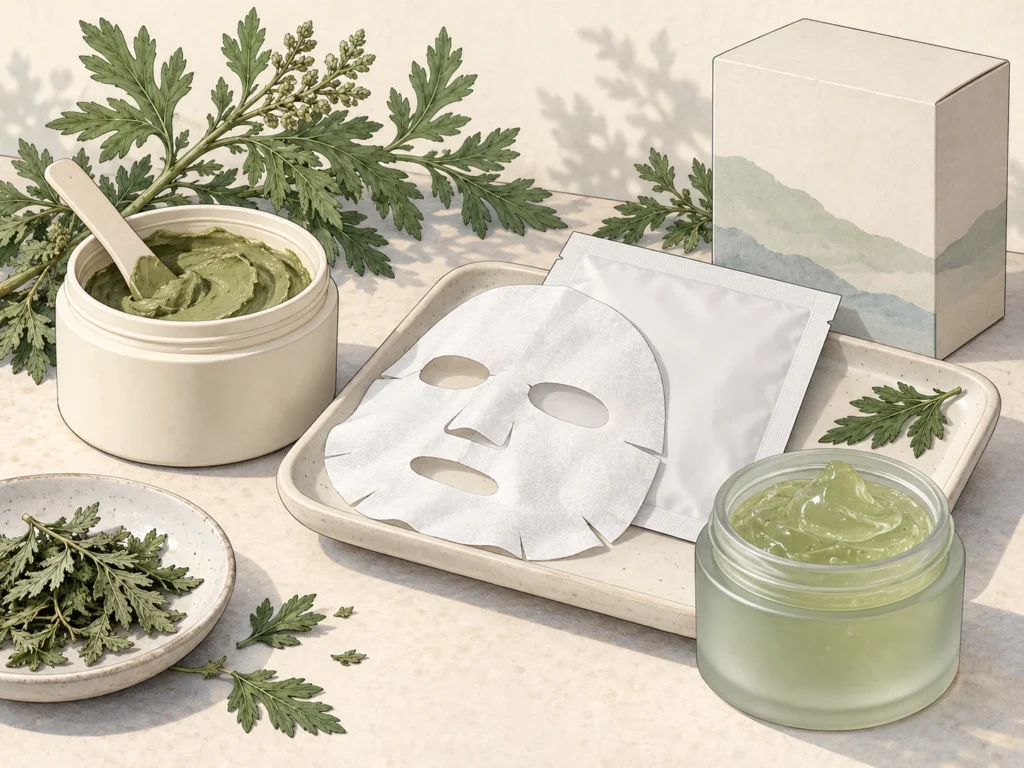
A mugwort mask is a facial mask formulated with a mugwort-derived ingredient. Choose by the complete formula, mask format, directions and packaging. A mugwort clay mask, a sheet mask and a gel wash-off mask offer different product experiences. Clay masks are usually wash-off products too, so “clay” and “wash-off” are overlapping descriptions, not opposite categories.
A green jar or a picture of mugwort leaves does not tell you what is inside. One mask may feature a botanical extract in a smooth gel. Another may combine clay with botanical ingredients, while a third uses a sheet soaked in a liquid formula.
This guide explains those differences for people comparing products and for overseas retailers or small brands planning a mugwort skincare range.
What makes a facial mask a mugwort mask?
The name usually refers to a mugwort-derived ingredient in the formulation. Check the full ingredient declaration for the botanical ingredient, its form and the other ingredients. Do not assume all products use the same plant species, extract or amount.
Different formulas can contain leaf powder, an extract or another prepared botanical ingredient. These are not interchangeable descriptions. Visible plant particles may be part of a product's appearance, but they do not establish its effectiveness or the quality of the complete formulation.
If you are looking for a particular brand, compare the current version of that exact product. Another product with similar packaging or a similar name may have a different formula and directions.
Clay, sheet and wash-off masks compared
| Format | What it is | Useful buying checks |
|---|---|---|
| Mugwort clay mask | A formula containing clay, commonly rinsed off after use | Clay ingredients, spreadability, removal, other ingredients and pack size |
| Mugwort sheet mask | A sheet or similar carrier supplied with a liquid skincare formula | Sheet material and fit, liquid distribution, pouch condition and directions |
| Other mugwort wash-off masks | Gel, cream or paste products designed to be rinsed off | Texture, particles if present, application and removal instructions, and packaging |
Use these descriptions to understand the product, rather than to rank one format above the others. The formula and the way it is used matter alongside the format.
What should you look for in a mugwort clay mask?
A clay mask may contain ingredients such as kaolin or bentonite. Clay can help absorb surface oil, but a clay ingredient does not establish that every formula suits every skin type.
Compare how easily the product spreads, whether the instructions are clear and how it rinses away. Check the whole ingredient list if you avoid fragrance, exfoliating ingredients or a particular botanical. Do not judge the formula solely by how dark green it looks or how firmly it dries.
For commercial samples, also record whether material separates, the lid or seal leaks, or the product becomes difficult to dispense. Informal sample observations help define questions for the manufacturer; they do not replace a proper assessment of the finished product.
What is different about a mugwort sheet mask?
A sheet mask combines a carrier with a liquid formula, usually inside a sealed sachet. The sheet, liquid and pouch all contribute to the finished product, so checking the ingredient list is only one part of comparing it.
Consider whether the sheet unfolds easily, fits as intended and carries the liquid evenly. For a retail purchase, check that the sachet is sealed and undamaged. For a brand project, request the sheet material, dimensions, liquid fill specification and packaging details.
“Essence” on a sheet-mask packet describes the supplied formula; it does not mean it is identical to a separately bottled essence. Our mugwort essence buying guide explains what to check when comparing those products.
How do gel and cream wash-off masks differ?
A wash-off mask is a product intended to be removed by rinsing according to its instructions. It may be a gel, cream, paste or clay-based formula. The term describes the removal method, not a single ingredient recipe.
Compare texture, application, removal and the amount you are likely to use each time. If plant particles are present, ask what they are and whether their size and distribution are part of the specification. A gritty appearance should not be treated as proof of a more natural or better product.
For a multi-use jar, examine the closure, inner seal if supplied and instructions for keeping the product in suitable condition after opening. For a tube, compare dispensing and whether the closure stays clean during normal handling.
How should you choose between the formats?
Start with the product experience you want. A sheet format may suit a preference for individual packs. A jar or tube may suit someone who prefers to control the amount applied. A clay-based formula may be marketed around oil absorption; other formulas may emphasize hydration or skin feel.
Check whether those purposes fit your existing routine. More botanical ingredients, more visible leaf material or a higher stated extract percentage do not automatically make the product more suitable.
Follow the product's directions, including removal time and frequency. Try a new product on a small area first. If a mask causes burning, itching or stinging, remove it and stop use. A facial mask should not be presented as a treatment for a skin disease.
Compare price per use, not only price per package
A box of sheet masks and a jar of wash-off product are difficult to compare by headline price alone. Check the number of sachets, the net contents and how much product the instructions require for each use.
For a brand or retailer, distinguish product cost from printing, cartons, freight and destination costs. Samples should represent the proposed formula, carrier and pack. A quotation for an unprinted standard sachet is not equivalent to one for custom printed packs and retail boxes.
What should a small brand confirm before ordering?
Choose the format before asking suppliers to quote. A mugwort mask brief should identify the destination, intended customer, pack size, formula preferences, order quantity and required packaging. Clarify whether you want an existing formula or a development project.
| Area | What to confirm |
|---|---|
| Formula | Complete ingredient information, botanical identity and intended cosmetic claims |
| Format | Clay, gel, cream or sheet specification; carrier and fill details where applicable |
| Packaging | Jar, tube or sachet, seals, printing, retail carton and transport protection |
| Product information | Relevant safety, stability, microbiological and packaging-compatibility information for review |
| Commercial terms | Product and packaging minimums, sample approval, lead times and change control |
Keep a labeled approval sample and record the agreed version. A later change to the formula, sheet material, fragrance or packaging needs a clear approval process. Ask which information applies to the exact product offered, rather than accepting documents for an unrelated formula.
GCB can help compare manufacturers, clarify quotations and coordinate samples and private label packaging. The actual skincare manufacturing capability needs to be checked for the project.
Frequently asked questions
Is a mugwort clay mask different from a wash-off mask?
A clay mask is commonly a type of wash-off mask. “Clay” describes part of the formulation; “wash-off” describes how the product is removed.
Is a mugwort sheet mask the same as mugwort essence?
No. A sheet mask includes a carrier and a supplied formula. A bottled essence is a separate finished product. Similar ingredient names do not establish identical formulations.
Does a higher mugwort percentage mean a better mask?
Not necessarily. Establish what the percentage measures, then review the complete formula, directions and supporting product information.
Can mugwort powder be used instead of a finished mask?
Raw leaf powder is an ingredient, not an equivalent replacement for a finished cosmetic mask. Mixing it with water does not establish a suitable or properly preserved skincare formula.
Can a small brand customize the packaging?
Yes, subject to supplier capability and packaging minimums. Discuss sachets, tubes, jars, labels and retail boxes separately from the formula and fill quantity.
What should I send when requesting samples?
Send the preferred mask format, destination, pack size, ingredient preferences, approximate quantity and packaging idea. Explain whether you need an existing formula or custom development.
Related guidance: OEM & Private Label · Samples & MOQ · Pricing & Payment
Updated October 18, 2026.
About Global China Bridge
Global China Bridge is a China-based sourcing and product-development service company helping overseas entrepreneurs, small brands, retailers and other small businesses work with Chinese manufacturers. We support supplier searches, factory verification, samples, OEM and private label packaging, production follow-up, quality checks and shipping coordination.
Planning a mugwort masks project? Tell us your target country, product requirements, approximate quantity and packaging idea. Small orders are welcome to discuss. We start with a free conversation, then agree a clear scope and fee for any work.