
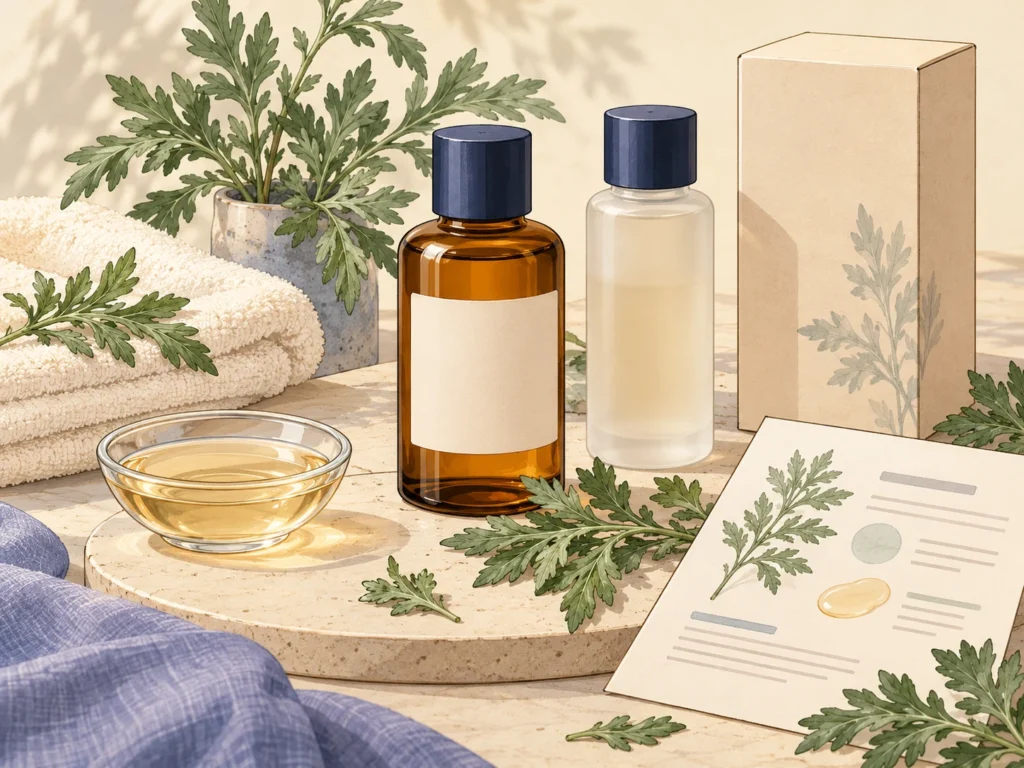
Mugwort essence is a leave-on skincare product formulated with a mugwort-derived ingredient, usually in a lightweight liquid. Before buying, check the complete ingredient list, intended cosmetic purpose, texture, directions and packaging. The word “mugwort” does not make different products equivalent, and a high extract percentage does not by itself show how a finished formula will perform.
You may have found mugwort essence through Korean skincare, a familiar brand or a recommendation for a simpler routine. The useful question is what a particular bottle contains and whether it suits your needs. If you are developing a brand, the same question becomes a specification problem: what exactly do you want a manufacturer to make?
This guide starts with product selection, then explains the extra information an overseas retailer or small brand should obtain before exploring production in China.
What is mugwort essence?
In skincare, “essence” generally describes a lightweight leave-on product used within a routine, often marketed around hydration or skin comfort. Mugwort essence features an ingredient derived from a plant in the Artemisia genus. Check the exact botanical ingredient on the label rather than assuming all mugwort products use the same species or preparation.
If you are looking for a particular branded essence, check that exact product and its current packaging. A review of one brand is not evidence that another product with “mugwort” in its name has an equivalent formula.
The category name does not specify one recipe. Two essences may differ in extract, solvents, humectants, fragrance, preservation system and consistency. Read the current label for the product and market you are buying; an older review may describe a different version.
Mugwort essence, toner, serum or extract: what is the difference?
| Name | What it commonly describes | What to check |
|---|---|---|
| Mugwort essence | A finished lightweight leave-on skincare product | Complete formula information, texture and directions |
| Mugwort toner | A finished liquid skincare product; positioning may overlap with essence | Actual function, other ingredients and whether it duplicates an existing step |
| Mugwort serum | A finished product positioned for a particular skincare purpose | Full formulation and supported claims, rather than assuming greater strength |
| Mugwort extract | A botanical ingredient that may be supplied for formulation | Species, plant part, extraction medium, concentration information and intended use |
| Mugwort essential oil | A different type of concentrated aromatic plant ingredient | Identity and suitable formulated use; do not substitute it for an essence |
These names are not a universal scale of strength. A serum is not automatically more concentrated than an essence, and a toner is not automatically less useful. Compare the actual products and the role each would have in the routine.
A raw extract is also not automatically a finished facial product. Buyers sourcing an ingredient and buyers sourcing a bottled essence need different specifications, suppliers and checks.
What benefits should you expect?
Look for clearly stated cosmetic purposes, such as hydration or improving how the skin feels. Ask what supports claims about the finished product. An ingredient story, a high percentage on the front label or a testimonial does not establish that a formula will deliver a particular result for every user.
For a buyer, the practical approach is to identify the purpose you need, read the whole formula and assess the finished product. For a brand, it is to agree the intended claims and evidence requirements before product development and label design.
How to read a mugwort essence ingredient list
Begin with the exact ingredient name. “Mugwort” is a common name, while a botanical ingredient declaration provides more specific information. Do not assume an ingredient used in one brand is the same as an ingredient offered by a raw-material supplier.
Then look beyond the featured botanical. Other ingredients contribute to texture, scent, preservation and the way the product feels. If you avoid a particular ingredient, check the current full list rather than a retailer's short marketing description.
What does a high extract percentage tell you?
First establish what is being measured. An extract is a prepared ingredient and can include an extraction medium. A percentage referring to an extract is not automatically the percentage of dry plant solids or any particular chemical constituent.
For bulk purchasing, ask the manufacturer to explain the extract specification and how the percentage is calculated in the final formula. Do not compare percentages across unrelated products as though they measure a standardized potency.
Does a short ingredient list mean it is better?
A shorter list can be easier to review, but it does not establish suitability or product quality on its own. Ask what the complete formulation contains and how the finished product is supported. A simple appearance should not replace a proper formulation and safety review.
A practical checklist before buying a bottle
- Product identity: confirm the exact product name, size and version.
- Formula: read the full ingredient list, including anything you prefer to avoid.
- Purpose: decide what role it would have in your existing routine.
- Texture: compare watery, more viscous or layered formats according to your preference.
- Directions: follow the specific product's instructions and storage information.
- Value: compare the price for the same volume, alongside authenticity, condition and seller reliability.
A product need not be added simply because the ingredient is popular. If an existing product already performs the role you need, an additional essence may be unnecessary.
How should you introduce mugwort essence into a routine?
Follow the manufacturer's directions for that formula. There is no universal number of drops, frequency or layering order that applies to every mugwort essence. Check how it fits with products you already use instead of adding several new items together.
Test a new skincare product on a small area before wider use. Follow the product instructions and stop using it if irritation occurs. Seek appropriate care if symptoms are significant or persistent.
If you are comparing samples for a business, keep informal feedback separate from professional product safety assessment. A few favorable sample comments do not establish safety for an entire customer population.
What should a brand ask before sourcing mugwort essence?
Start with a product brief rather than asking a factory to “make the same one” as a popular brand. Describe the intended market, customer, texture, pack size, target price range and acceptable claims. Identify whether you need an existing formula with packaging changes or a development project.
| Area | Information to request |
|---|---|
| Formula and botanical ingredient | Full ingredient information, extract identity and explanation of any percentage claim |
| Manufacturing responsibility | Identity of the actual manufacturer and which steps are performed at its facility |
| Product assessment | Relevant safety, stability, microbiological and packaging-compatibility information for qualified review |
| Packaging | Bottle, closure, dispensing, leakage protection, label and carton specifications |
| Commercial terms | Separate formula and packaging MOQs, sample charges, lead times and change-control arrangements |
| Destination requirements | Required documents and responsibilities for local review, labeling and market access |
Ask whether test information covers the actual formula in the proposed packaging. A certificate for a raw ingredient does not answer every question about a bottled finished product. Arrange qualified assessment for the destination before committing to a production run.
Private label packaging: what can be discussed?
Private label packaging can include the bottle, cap or pump, label design, outer carton, pack size and shipping protection. These choices should be discussed alongside the formula, because a visually attractive pack still needs to dispense, protect and contain the product appropriately.
Confirm packaging minimums separately from the fill quantity. Ask for an approval sample and clarify who checks the artwork, ingredient declaration, batch coding and required destination wording. Agree how later formula or packaging changes will be communicated.
GCB can help explore Chinese supplier options and coordinate those discussions. A mugwort-processing factory or a moxa supplier should not automatically be treated as a qualified skincare manufacturer. The actual production capability and project requirements need to be checked.
Bryan's view: For a first skincare project, clarity is worth more than a fashionable ingredient name. Define the product, identify who will make it and settle the sample and packaging requirements before discussing a larger order.
Frequently asked questions
Is mugwort essence the same as mugwort toner?
Their positioning can overlap. Compare the formula, texture, intended purpose and instructions. The name alone does not establish which is stronger or more suitable.
Is mugwort essence the same as mugwort essential oil?
No. A finished essence and an essential oil are different product types. Essential oil should not be substituted directly for a facial essence.
Is a higher mugwort extract percentage always better?
No. First establish what the percentage refers to and the extract's specification. The complete formulation and supporting product information matter more than a percentage alone.
Can people with sensitive skin use mugwort essence?
Suitability depends on the individual and exact formula. Check the ingredient list and test a new product before wider use. A natural or botanical description does not guarantee that it will not cause irritation.
Can a small brand source a private label mugwort essence?
Potentially, subject to suitable manufacturing capability, formula and packaging minimums, and destination requirements. Start with a clear brief and samples; do not assume a universal MOQ or development cost.
What should I send GCB for an initial discussion?
Send your target country, whether you want a finished product or ingredient, intended pack size, approximate quantity, reference preferences and packaging idea. Tell us if this is a new formula or an existing-product project.
Related guidance: OEM & Private Label · Samples & MOQ · Pricing & Payment
Updated October 17, 2026.
About Global China Bridge
Global China Bridge is a China-based sourcing and product-development service company for overseas entrepreneurs, small brands, retailers and other small businesses. We help turn a product requirement into practical supplier discussions, supporting manufacturer searches, supplier verification, samples, private label packaging, production follow-up, quality checks and shipping coordination.
Exploring a mugwort skincare product? Share your market, product idea, approximate quantity and packaging needs. We can discuss the next sourcing task and check what supplier capability the project requires. Start with a free conversation; any paid work has an agreed scope and fee.
Email: service@globalchinabridge.com · Meet Bryan and learn about GCB