
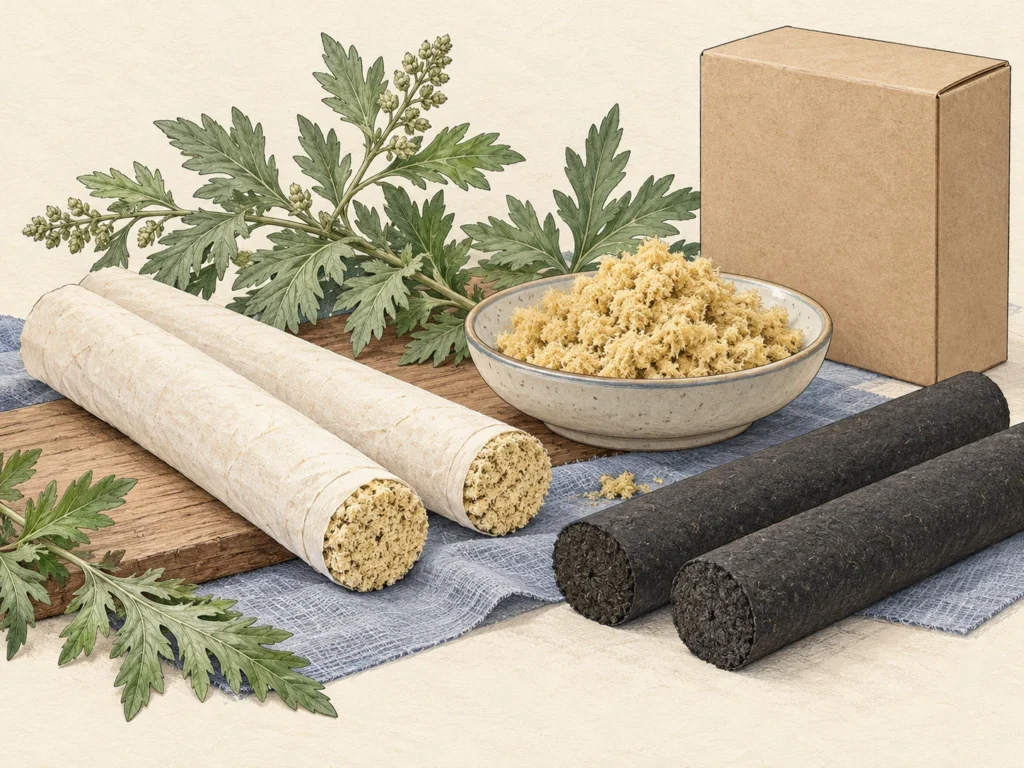
Quick answer: Traditional pure moxa rolls and smokeless moxa sticks should be compared by composition, dimensions, handling and observed burning performance. An aging claim or a higher moxa ratio is a starting point for verification, not proof of a better product. Choose samples that fit the clinic's equipment and operating conditions before committing to a wholesale order.
For overseas acupuncture clinics, TCM (Traditional Chinese Medicine) schools and wellness distributors, sourcing consistent moxibustion supplies can be a difficult task. The quality of a pure moxa roll affects product consistency, practitioner handling and the experience of the people using it.
Labels do not always tell the whole story. A claim such as “35:1, 5-year aged moxa” needs supporting records and a clearly defined specification. Buyers should establish what the supplier means by the ratio and the aging period rather than paying a premium for the wording alone.
At Global China Bridge, we help reduce this uncertainty. We work as your sourcing service team in China. You focus on serving your customers and distributing to local clinics, while we help verify factories, review raw materials, follow production and coordinate packaging and shipping. On-site work is arranged around the agreed project scope.
Here is a professional buyer's guide to sourcing the right moxa sticks for your business.
Why Professionals Look Closely at Qichun Moxa
Qichun, in Hubei Province, China, is a recognized production area associated with moxa products. For a buyer considering aged Qichun moxa, the useful question is not simply whether “Qichun” appears on the box, but what the factory can establish about the material behind that name.
Ask where the mugwort was grown, where it was processed and where the finished sticks were made. These may be different locations. A factory address in Qichun does not by itself establish the origin of every batch of leaves.
As your sourcing partner, we can investigate candidate factories in the relevant production areas and compare their sourcing records, processing methods and samples. Origin, age and processing grade should each be checked separately. None alone proves a particular therapeutic result.
Decoding Moxa Ratios: What 5:1, 15:1 and 30:1 Actually Mean
A moxa ratio is commonly presented as the weight of dried leaf input used to produce a unit weight of moxa floss (moxa wool). For example, a stated 15:1 ratio usually describes 15 units of leaf input for one unit of floss output. Ask the factory to confirm its definition, starting material and calculation method.
This is a processing description, not a standardized percentage-purity score. Ratios from two suppliers are not automatically comparable. Stick diameter, weight, compression, wrapping and moisture can also affect how a finished roll performs.
- 5:1 to 10:1: Often sold as less-refined grades, with more visible leaf particles. Review the actual floss and finished-stick sample rather than assigning a use solely from the ratio.
- 15:1 to 20:1: Often marketed as more-refined grades. Check texture, visible fragments, rolling consistency and batch repeatability.
- 30:1: Often marketed as highly refined or “golden” moxa. Color and softness can inform a comparison, but do not prove the stated yield or age.
- 35:1 or 40:1 claims: A larger number deserves questions, but it is not automatically evidence of fraud or a physically impossible product. Request a definition, production records and a sample comparison before deciding whether the premium is justified.
| Label claim | What to ask the factory | What it does not prove |
|---|---|---|
| 30:1 moxa | What material and input/output weights are used? | A universal purity level or gentler heat |
| 3-year or 5-year aged | Are the years counted from harvest, leaf storage or finished production? | Age confirmed by smell alone |
| Qichun origin | Can the incoming material be linked to origin and batch records? | Origin established by a brand or factory address |
Pure Moxa vs. Smokeless Moxa Sticks: Which to Source?
Your choice depends on the end user's working environment, equipment and product requirements.
- Traditional pure moxa rolls: These are typically paper-wrapped moxa floss products. They retain the familiar herbal aroma and produce visible smoke. Confirm that “pure” means the agreed ingredient composition, and check dimensions, firmness, ash behavior and compatibility with the intended holder.
- Smokeless moxa sticks: These are commonly made from carbonized material and are intended to reduce visible smoke and odor. Formulations and binders vary. Ask what they contain, how they are produced and how the finished sticks behave during handling and burning.
“Smokeless” does not mean emission-free or suitable for an unventilated room. Burning products can still release gases and other combustion products. The buyer should assess ventilation and local operating requirements; a low-smoke label is not permission to disregard a smoke alarm or building rule.
We help compare suppliers' declared ingredients and representative samples. We do not treat a “natural adhesive” claim as proof that a binder is harmless when burned, or a clean-looking burn as complete evidence of safety.
How We Audit Moxa Factories to Protect Your Business
Factory documents and physical inspection work best together. An on-site visit can show how material is stored, processed and packed; batch records help connect those observations to the order. Neither should be replaced by a convincing sales photograph.
- The touch and smell check: We examine accessible floss and storage conditions, looking for dampness, visible foreign material and inconsistencies between samples. Texture and aroma are useful comparison points, but cannot authenticate three or five years of aging. Harvest, storage and processing records matter.
- The burn and ash comparison: An agreed sample check can record ignition behavior, burn consistency, visible smoke, cracking and ash retention under comparable conditions. This is a product comparison, not a treatment trial. Ash color alone does not establish quality, and retained ash still requires careful handling.
- Paper and wrapping QC: We review the declared paper type, added ingredients, seam quality, rolling firmness and dimensions. Mulberry paper or an “unbleached” label is not by itself proof that combustion produces no undesirable emissions.
For a wholesale order, we also agree the inspection sample, acceptable defects, packaging count and batch identification. Keep an approved reference sample and document changes before repeat production. Buyers can read more about our quality control support.
Request Factory Quotes and a Moxa Sample Comparison
Are you a clinic supplier or TCM distributor? Let us be your sourcing arm in China. Tell us your target country, intended product type, dimensions, quantity and packaging idea. We can discuss factory quotes and a sample selection covering the ratios and smokeless options relevant to your project. Sample availability, preparation costs and international freight are confirmed before arranging the package.
Discuss moxa quotes and samples
Frequently Asked Questions
Is a higher moxa ratio always better?
No. The factory's definition, material and processing method matter. Compare finished samples and repeatability against your requirements rather than buying the largest number on the label.
Can smell confirm that moxa is five years old?
No. Aroma may help compare samples, but does not authenticate age. Ask how the aging period is defined and review the records linking stored material to the batch.
Are smokeless moxa sticks completely smoke-free?
They are intended to reduce visible smoke, but performance varies and combustion emissions remain a consideration. Review the actual product and its instructions alongside the facility's ventilation arrangements.
Does Qichun origin guarantee a better finished stick?
No. Origin is one specification. Material handling, processing, wrapping, storage and batch consistency also need attention.
Can GCB arrange private label moxa packaging?
Yes. We can discuss labels, cartons, pack counts and factory coordination. The feasible quantity and cost depend on the stick specification and packaging work.
What should I send for a sourcing discussion?
Send your target market, product type, dimensions, approximate quantity, holder requirements and packaging preference. Existing samples or photos can make the comparison more specific.
Related guidance: Moxa Sticks: Types and Sizes · OEM & Private Label · Our Moxa Sourcing Story
Updated October 18, 2026.
About Global China Bridge
Global China Bridge is a China-based sourcing and product-development service company helping overseas entrepreneurs, small brands, clinic suppliers, distributors and other small businesses work with Chinese manufacturers. We support supplier searches, factory verification, samples, OEM and private label packaging, production follow-up, quality checks and shipping coordination.
Planning a moxa consumables project? Tell us your target country, product requirements, approximate quantity and packaging idea. Small orders are welcome to discuss. We start with a free conversation, then agree a clear scope and fee for any work.