
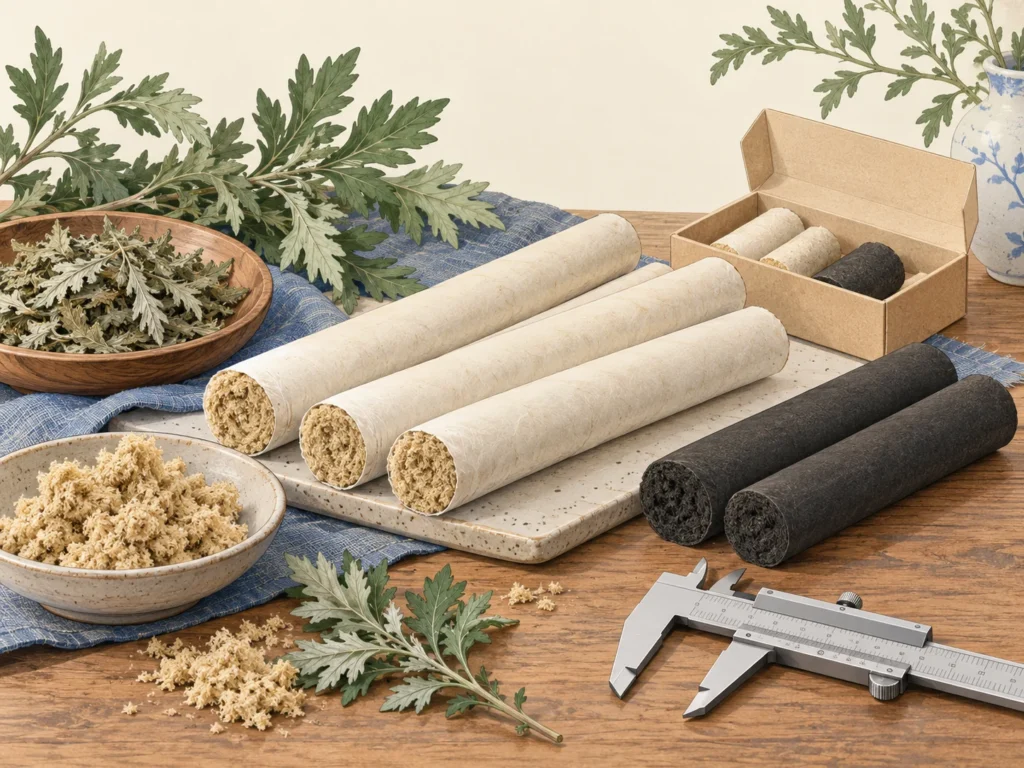
Moxa sticks are cylindrical products made for moxibustion, a traditional practice that uses heat from burning moxa. When buying them, compare the product type, ingredients, diameter, length, holder compatibility and packaging. Traditional paper-wrapped rolls, smokeless rolls and short stick-on products need different checks. A description such as “pure,” “aged” or “30:1” needs clarification before it becomes a reason to pay more.
Two boxes can look similar online and behave differently when opened. One roll may be the wrong diameter for an existing holder. Another may contain additional herbs, arrive with broken ends or have a smell that the intended users did not expect.
This guide explains the product differences and a practical buying checklist for overseas clinics, retailers and small brands. It addresses product selection and sourcing, rather than treatment technique.
What are moxa sticks made from?
Traditional moxa commonly uses processed mugwort leaf material, often described as moxa wool or moxa floss, formed into a roll with a paper wrapper. Suppliers may also offer blends containing other herbs. Smokeless products often use carbonized material and may contain binders or other ingredients.
Ask what is inside the exact product being quoted. “Moxa” on the carton does not identify the botanical source, processing method or complete composition. If an ingredient matters to your customers, put it in the purchasing specification and request supporting information.
Moxa sticks and moxa rolls are frequently used as overlapping sales terms. A short moxa cylinder may also be described as a stick, cone or stick-on product. Use dimensions and photographs of the actual item to resolve the terminology.
Which type of moxa stick should you compare?
| Product format | Typical construction | Check before buying |
|---|---|---|
| Traditional moxa sticks | Processed plant material in a paper-wrapped roll | Ingredients, roll firmness, dimensions, wrapper and burning characteristics |
| Smokeless moxa sticks | Often carbonized material formed into a firm roll | Composition, odor and smoke under the intended conditions, lighting behavior and breakage |
| Short moxa rolls or cylinders | Short pieces supplied loose or for a particular device | Length, outside diameter, center hole if present, and device compatibility |
| Stick-on moxa | A short moxa component mounted on a base | Complete assembly, packaging protection and manufacturer instructions |
These are purchasing categories, not interchangeable treatment options. The intended practitioner should choose the appropriate format. A product that fits inside a device is not automatically approved for use with it.
Traditional vs. smokeless moxa: what changes for the buyer?
The useful comparison goes beyond the amount of visible smoke. Ask how the product is made, what it contains, how it is packaged and what the intended user notices during a supervised evaluation.
For traditional rolls, compare the wrapper, firmness, loose material, odor, smoke and ash behavior. For smokeless rolls, also look for cracks, crumbling or damage from transport. Obtain samples of the exact proposed specification rather than assuming all dark-colored rolls are equivalent.
“Smokeless” should not be interpreted as a guarantee of no emissions, no odor or no need for ventilation. Ask the manufacturer to explain the claim. Burning products still require appropriate supervision, ventilation and fire precautions. Supplier instructions should accompany the product; medical suitability belongs with a qualified practitioner.
Confirm diameter, length and holder compatibility
Ask for dimensions in millimeters and a photograph showing how they were measured. Confirm whether the quoted diameter includes the wrapper and what variation the supplier accepts between pieces.
If you already use a moxa holder or box, send its model, internal dimensions and manufacturer requirements. For hollow cylinders, specify both outside diameter and hole size. For mounted products, request the dimensions of the complete assembly.
A useful sample check includes:
- Measure several pieces, not only the first roll in the box.
- Compare the approved size with the actual holder requirements.
- Look for flattened ends, damaged wrappers and inconsistent shaping.
- Confirm the number of pieces per inner pack and retail box.
- Retain a labeled sample for comparison with the production batch.
A short video can help clarify dimensions or handling, but it does not replace physical samples or confirmation from the device supplier.
How should you read “aged moxa,” origin and ratio claims?
A listing may emphasize Qichun, another production area, a stated storage period or a ratio such as 5:1, 15:1 or 30:1. Treat each as a claim to explain and document.
Ask whether the location refers to where the plant was grown, where it was processed or where the seller operates. For an age claim, establish what material was stored, how the time was counted and what records support it.
For a ratio, ask exactly what the two numbers represent and how the supplier calculates them. A ratio by itself does not establish a common quality standard across factories. Color and photographs are also insufficient proof of age or purity.
Start with the performance and consistency your buyer needs. Then decide which origin, processing and storage claims are important enough to include in the order documents.
Build a sample comparison that you can repeat
Label each sample with the supplier, product code, specification and date received. Keep the retail box and any instructions with it. If you compare several suppliers, use the same checklist and record the intended user's observations separately from the supplier's claims.
Where burning characteristics need evaluation, arrange this with an appropriate practitioner or competent provider under suitable conditions. Record the product and evaluation conditions. Do not turn an informal sample demonstration into a certified safety or emissions test.
Before a commercial order, agree which sample becomes the reference and which defects are unacceptable. Discuss broken pieces, loose wrappers, wrong counts, incorrect dimensions and packaging damage. Set the inspection method and acceptance criteria before production.
What should a wholesale moxa quotation include?
Send the same brief to each candidate supplier. Otherwise, one quotation may cover plain rolls in a bulk bag while another includes individual packing, printed boxes and export cartons.
| Specify | Ask the supplier to confirm |
|---|---|
| Product type and composition | Exact model, material information and any additives |
| Dimensions and quantity | Agreed tolerances, pieces per box and order quantity |
| Packaging | Inner protection, retail box, outer carton and printing scope |
| Samples and production | Sample charges, approval process and lead-time starting point |
| Delivery and checks | Trade term, inspection arrangements and relevant shipment documents |
There is no reliable universal MOQ or factory price for all moxa sticks. The product, materials, packaging and printing run affect the quote. Compare the delivered specification and cost, including freight and destination charges, before deciding that one offer is cheaper.
Can you arrange private label packaging?
Yes. GCB can help overseas buyers discuss private label packaging with Chinese suppliers, including box format, logo placement, artwork coordination, inner packing and carton requirements. Product and packaging details can be worked through before the order.
Confirm separate minimum quantities for the product and printed packaging. Ask who owns the artwork, how the printed sample will be approved and what happens to unused packaging. Check destination wording and instructions with an appropriate local adviser before printing.
For help with supplier selection, samples and packaging, see our moxa and mugwort product sourcing service. For background on our actual China-side work, read the moxa sourcing project for an overseas buyer.
Bryan's view: An approved sample is most useful when everyone knows what was approved. Write down the dimensions, material description, packing and acceptance points while the sample is still on the table.
Frequently asked questions
Are moxa sticks and moxa rolls the same?
The names often overlap in product listings. Confirm the actual construction, length, diameter and intended holder rather than relying on the name alone.
Are smokeless moxa sticks completely smoke-free?
Do not assume so. Ask the manufacturer what its claim means and evaluate the exact item. Reduced visible smoke does not establish the absence of emissions or remove ventilation requirements.
Does a higher moxa ratio always mean better quality?
No. First establish how the supplier defines the ratio. Compare composition, consistency, samples and records against your requirements instead of ranking suppliers by a number alone.
Can I order a small quantity with my own packaging?
It depends on the product and packaging run. Ask for the minimum quantities separately. A standard box with an agreed label may be worth comparing with a fully printed box for a first order.
What should I send when requesting moxa samples?
Send the intended product format, dimensions or reference photos, destination, approximate order quantity and packaging needs. Include holder information where compatibility matters.
What should be checked before shipment?
Check the agreed product identity, dimensions, condition, quantity, packaging, labels and batch information against the order and reference sample. Confirm the inspection scope and destination documentation in advance.
Related guidance: Samples & MOQ · OEM & Private Label · Pricing & Payment
Updated October 17, 2026.
About Global China Bridge
Global China Bridge is a China-based sourcing and product-development service company helping overseas entrepreneurs, small brands, retailers and other small businesses work with Chinese suppliers. We help find manufacturers, verify suppliers, coordinate samples and private label packaging, and follow production, quality checks and shipping.
Planning to source moxa products? Tell us your destination, product type, approximate quantity and packaging idea. Small orders are welcome to discuss. We start with a free conversation, then agree a clear scope and fee for any work.
Email: service@globalchinabridge.com · Meet Bryan and learn about GCB