
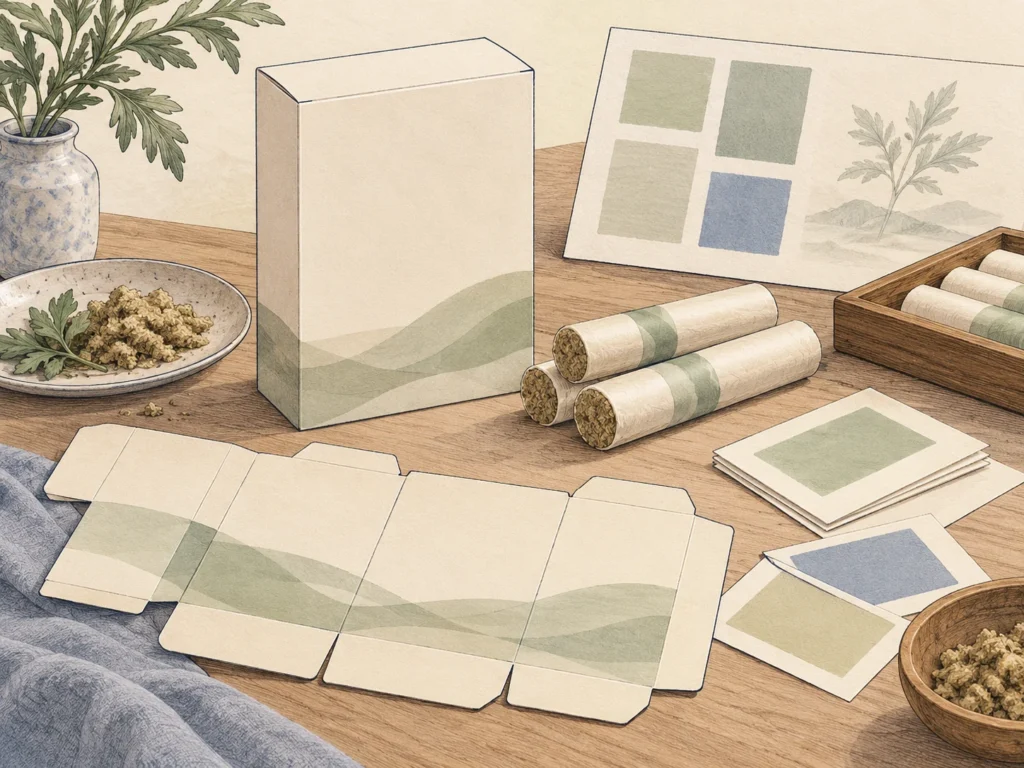
Quick answer: A private label moxa project should start with an approved product, then move to pack structure, artwork, instructions and a complete packed sample. Confirm product MOQ and printed packaging MOQ separately. Your logo is one part of the job; the finished pack also needs to identify what is inside and support a consistent repeat order.
You may already know the customers you want to serve: clinic suppliers, specialist retailers or a small wellness distribution network. The next question is how to turn a factory's existing moxa product into an offer carrying your own brand.
Private label packaging is a practical place to begin. It can let a new brand work with an existing product while developing its own presentation and sales materials. The important step is to agree exactly what changes and what remains the factory's established product.
Choose the Product Before Designing the Box
A traditional roll, a carbonized stick and a pack of stick-on units need different packaging. Product size, pack count, fragility and included accessories determine the inner structure. Design work becomes expensive when those decisions change after the artwork is finished.
Start with a named factory reference and a sample. Confirm the composition description, dimensions, pack quantity and any holder requirements. Record which reference the packaging will be designed around.
“Use the same quality as the sample” leaves too much unstated. Keep an identified sample and a written specification so the factory, printer and buyer are working from the same version.
What Can Private Label Moxa Packaging Include?
The simplest project may involve an existing product and a new label. A more developed project can include printed cartons, protective inner packs, inserts and shipping cases. Choose the work that helps the buyer understand and receive the product, rather than adding complexity only for appearance.
| Packaging element | Decision to make | Approve before production |
|---|---|---|
| Product identification | Name, reference, quantity and description | Consistent wording across the pack and order |
| Inner protection | Bag, tray, wrap or another suitable structure | Fit, closure and protection of the actual product |
| Retail carton | Size, board, finish and opening style | Dieline, print proof and physical sample |
| Instructions | Approved content and languages | Text linked to the exact product version |
| Shipping case | Pack count, protection and markings | Complete packed configuration |
Understand Product MOQ and Packaging MOQ
A supplier may accept a smaller quantity of an existing product but require a larger run of printed cartons. Different products can also share a packaging supplier while using different factory production lines.
Ask for the minimum quantity for each part of the project: product, inner pack, printed label, retail box and any custom accessory. Then ask how they combine into the minimum complete order.
If printed packaging exceeds the first production run, establish who owns the unused stock, where it will be stored, how long it can be retained and what happens if the artwork changes. Leftover cartons should be a deliberate decision, not an unexpected invoice.
For an initial order, an existing carton with a suitable label may be worth comparing with full custom printing. Neither option is automatically better; compare appearance, quantity, cost and the next repeat order.
Prepare Artwork and Instructions Together
The printer needs the final dieline and print-ready artwork. The production team needs clear information about which product and pack count go into that box. Give both teams the same version reference.
Review wording carefully. Origin, aging, composition and “smokeless” descriptions should match the actual product and available support. Do not add claims simply because another brand uses them. Instructions and warnings should be reviewed for the specific product and target market before printing.
A barcode, translated text or a polished design does not by itself establish that the product is ready for every sales channel. Confirm the required product information and responsibilities for the intended destination early enough to avoid reprinting.
Approve a Complete Packed Sample
A digital proof can help check artwork but cannot show how the product fits inside the carton. Request a complete packed sample where practical, using the intended inner protection and instructions.
- Fit: Does the product sit securely without crushing, rubbing or excessive movement?
- Count: Does the physical pack contain the declared quantity and every included component?
- Print: Are small text, color, logo placement and important product details clear?
- Handling: Can the pack be opened and closed as intended without damaging the contents?
- Identification: Is there an agreed way to connect the retail pack to its production lot?
Record any differences between a prototype and the planned production pack. Approving a hand-cut sample should not leave uncertainty about the final material, printing process or packing method.
Keep Production Changes Under Control
Private label work becomes more manageable when the factory, printer and buyer share a short approval sequence. You should know what is awaiting a decision and what has already been released for production.
| Stage | Required decision |
|---|---|
| Product sample | Confirm the product reference and specification |
| Pack structure | Confirm dimensions, protection and pack count |
| Artwork and text | Approve the final version and language content |
| Packed sample | Confirm the complete physical presentation |
| Production release | Approve quantity, schedule and the agreed inspection scope |
Global China Bridge can help connect those tasks: supplier communication, packaging coordination, sample follow-up and agreed pre-shipment checks. You handle your market and brand decisions; we help translate them into work the Chinese manufacturers can execute. Our OEM and private label service explains the broader process.
Frequently Asked Questions
Can I start with an existing moxa product and my own label?
Yes, this is an option to discuss with the supplier. Confirm the product reference, label content, quantity and the factory's ability to apply the packaging consistently.
Why can packaging MOQ be higher than product MOQ?
The printer and product factory may have different production requirements. Ask for separate quantities and how they affect the complete order.
Should I design the carton before sampling?
It is better to confirm the product and pack count first. Otherwise a change in size or construction can require a new dieline and artwork.
Does GCB provide a fixed low MOQ?
No universal quantity applies. We can help compare practical options based on the product, packaging process and factory.
Who approves the English instructions?
The buyer and relevant manufacturer should agree the final content and any necessary review for the product and destination. Translation should not introduce unsupported claims or different operating instructions.
What should I send for a packaging discussion?
Send the product reference, target country, approximate order quantity, pack count, logo or design direction and any required languages. Existing packaging examples are helpful.
Related guidance: Moxa Product Sourcing · Our Moxa Sourcing Story · Samples & MOQ
Updated October 18, 2026.
About Global China Bridge
Global China Bridge is a China-based sourcing and product-development service company helping overseas entrepreneurs, small brands, clinic suppliers, retailers and other small businesses work with Chinese manufacturers. We support supplier searches, factory verification, samples, OEM and private label packaging, production follow-up, quality checks and shipping coordination.
Share your product reference, target country, planned pack count, approximate quantity and design idea. We can discuss a practical packaging route and the sample approvals needed. Small orders are welcome to discuss. We start with a free conversation, then agree a clear scope and fee for any work.