
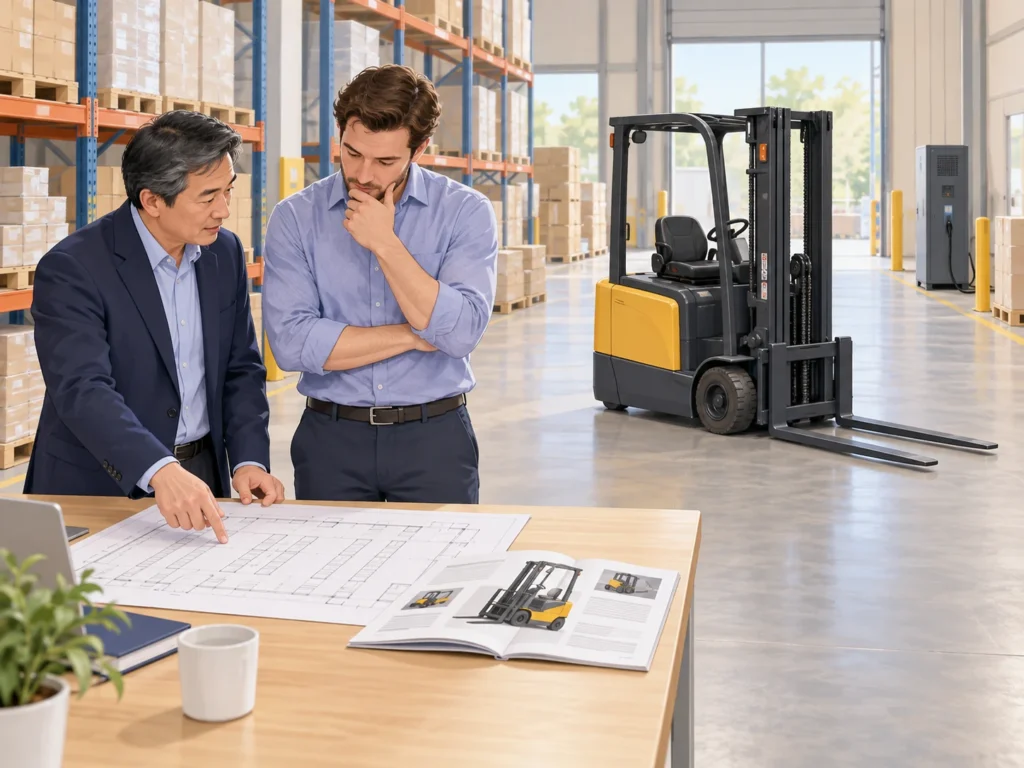
A small electric forklift is useful when its handling capability matches your load and its working dimensions match your building. Start with the task: moving pallets across the floor, stacking into racking or loading vehicles. Then compare equipment types. The words small, compact and mini do not define a standard machine, lifting capacity or aisle requirement.
What does small electric forklift actually mean?
Buyers often use the phrase for several different machines. One person means a compact sit-down counterbalance truck. Another means a walk-behind pallet stacker. A third needs a low-lift pallet truck for moving deliveries around a stockroom. Similar names in online listings can hide these differences.
A useful starting question is: where must the load go? Describe its starting position, travel route and final placement. A machine that moves a pallet comfortably across the floor may not be designed to place it on a high rack. A truck with sufficient lift height may still need more turning room than you have.
Compare the equipment category before comparing models
A pallet jack, also called a pallet truck, is mainly a horizontal transport choice. A stacker adds lifting for stacking, but its support-leg arrangement must suit the pallet and racking. A counterbalance forklift supports the load differently and may suit tasks where support legs would interfere. Actual capability depends on the model.
Walk-behind, stand-on and sit-down describe operator arrangements, not interchangeable capacity classes. Ask which arrangement the offered model uses. Three-wheel and four-wheel counterbalance designs also need model-specific comparison. Wheel count alone does not tell you the aisle width required for your load.
| Equipment group | Typical purpose | Key question before selection |
|---|---|---|
| Electric pallet truck | Move pallets over a suitable floor | Do you need transport only, or actual stacking? |
| Walkie stacker | Lift and position compatible pallet loads | Do support legs and pallet openings fit the job? |
| Compact counterbalance forklift | Handle loads where a counterbalanced design suits the site | Can the configured truck handle the load and complete the manoeuvre? |
| Portable or truck-mounted equipment | Specialised delivery or transport tasks | Does this specific design fit your unloading and transport arrangement? |
Use dimensions that describe the whole job
Measure the narrowest doorway, overhead obstructions, working aisles and corners on the actual route. Ask whether the quoted overall length includes the forks. Check mast lowered height separately from lifting height, and ask about free lift if lifting under a low roof is part of the task.
Turning radius describes one movement of the truck. A working aisle specification accounts for a particular handling arrangement and load dimensions. Give the supplier your pallet size and approach direction rather than assuming that a compact electric forklift can turn into every narrow rack aisle.
Vehicle weight also matters for floors, docks and delivery arrangements. Rated capacity is the load rating, not the shipping weight. Confirm the complete truck weight and any relevant floor or wheel-load information with the manufacturer and the person responsible for the building.
Start capacity discussions with the actual goods
Record the heaviest load including its pallet or container, its dimensions and where the weight is concentrated. Ask the manufacturer to confirm suitability at the required height and load centre. Long or uneven loads deserve a specific discussion, even when their total weight looks comfortably below the advertised capacity.
The 800–3,000 kg range we discuss with buyers describes a sourcing scope, not one compact design. Do not choose a larger nominal rating as a substitute for checking the load, attachments and placement height together.
Match the truck to the surface and work pattern
Describe floor joints, thresholds, slopes, loading areas and any outdoor travel. A small warehouse truck is not automatically a rough-terrain vehicle. Rain, dust and cold-storage conditions also need the manufacturer's written confirmation for the proposed configuration.
Then describe how much work happens each day. A few delivery movements and repeated lifting throughout a shift create different energy and maintenance needs. Confirm available charging time and site power before choosing a battery option. Pure electric does not necessarily mean lithium-ion.
Choose for continued use, not only first delivery
Before ordering, ask who can service the equipment locally, how replacement parts are identified and what the warranty actually covers. A small business with no maintenance support may find a local purchase more practical, even if an overseas quotation looks lower.
A compact footprint should make your workflow easier. If the proposed truck needs awkward pallet changes, repeated repositioning or charging during your busiest period, reconsider the category before negotiating the price.
A practical brief to send a supplier
Send one short document containing the load weight and dimensions, pallet type, required placement height, route measurements, floor conditions, daily workload, power supply, destination and quantity. Include photographs or a simple floor plan where they explain a constraint.
Ask each candidate to identify the proposed model, explain why it fits and list any unresolved assumptions. This produces a more useful comparison than collecting several prices against the phrase mini electric forklift.
For the later purchasing stage, our existing compact forklift buying checklist covers supplier confirmations. This article helps you decide which equipment category belongs on that checklist in the first place.
Frequently asked questions
Is a mini electric forklift a separate technical category?
No universal category is established by the word mini. Ask for the actual equipment type, operator arrangement and model data.
Is a pallet stacker the same as a forklift?
Listings may use the terms loosely. Compare the support arrangement, lifting function and pallet compatibility rather than relying on the product name.
Does a three-wheel truck always need less aisle space?
Do not assume so. Compare the working aisle requirements for the actual models and pallet dimensions.
Can I choose by rated capacity alone?
No. Load dimensions, required height, attachments and site constraints need to be considered with capacity.
Does electric mean lithium battery powered?
No. Electric forklifts can use different battery technologies. Confirm the battery and charger supplied with the exact model.
What should I prepare before asking GCB for help?
Send the load, lifting task, site measurements, working conditions and destination. We can discuss what should be clarified before sourcing begins.
Discuss your equipment requirements
Describe the load and the space it needs to move through. GCB can help clarify the equipment brief and coordinate questions with candidate manufacturers in China.
Global China Bridge helps overseas entrepreneurs and small businesses coordinate product sourcing, manufacturer verification, production follow-up and agreed quality checks in China. The introductory conversation is free. Any paid task starts with an agreed scope, deliverables and fee.
Discuss Your Forklift Requirements
Email: service@globalchinabridge.com.
Related sourcing support
Updated: October 18, 2026