
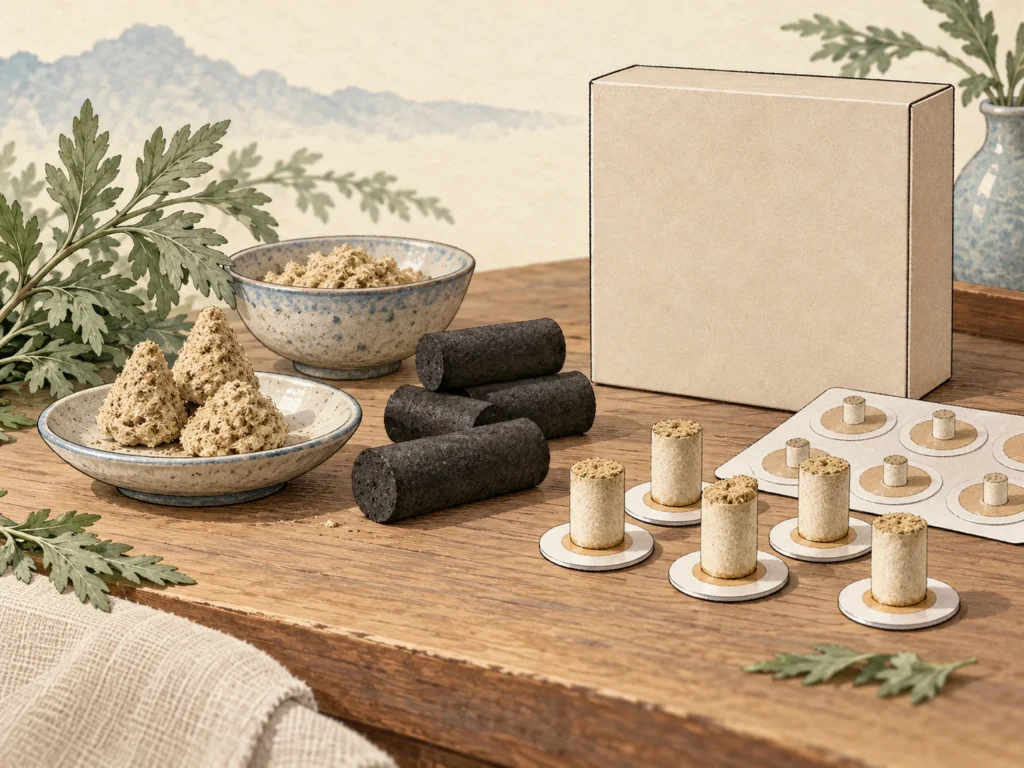
Quick answer: Moxa cones and stick-on moxa describe several different consumable formats. Compare the exact unit, material, dimensions, base or holder, packaging count and instructions. Similar photographs or a shared “mini moxa” name do not establish that two products are interchangeable.
A distributor may ask for “small moxa cones” and receive quotations for loose formed cones, carbonized units and adhesive-base cylinders. The prices may look comparable even though the products are not.
Before comparing factories, identify the format your customers already use or want to evaluate. This makes samples more useful and helps avoid buying a consumable that does not fit the intended equipment or sales channel.
Moxa Cones, Mini Moxa and Stick-On Moxa: What Is the Difference?
The term moxa cone may refer to a formed piece of moxa or a product made for a particular holder. Stick-on moxa typically combines a small consumable with a base and adhesive backing. “Mini moxa” describes size informally and does not define one construction.
Some commercial formats are made from fibrous material, while others use carbonized material. Supplier descriptions should identify the actual construction and any additional components. The appropriate use method must come from the specific product's instructions and qualified user assessment.
| Format | Confirm with the supplier | Common purchasing mistake |
|---|---|---|
| Formed fibrous cone | Material, unit dimensions and intended product configuration | Assuming every cone is ready to use in the same way |
| Carbonized unit | Composition, shape, additives and compatible holder | Treating “smokeless” as a complete specification |
| Stick-on unit | Consumable, base, adhesive, backing and complete instructions | Comparing only the visible moxa portion |
| Device-specific refill | Exact device reference and required dimensions | Buying a visually similar refill without checking fit |
Start With the Complete Unit
Ask for images showing the top, side, underside and packaging. For a stick-on product, the base, opening, adhesive area and release backing are part of the unit being purchased. A quote for the moxa portion alone is not a quote for a finished retail product.
Confirm the dimensions that determine fit and handling. Depending on the construction, these may include unit height, outer diameter, an opening or the base footprint. Put the agreed dimensions and tolerances into the specification rather than relying on a ruler in a sales photograph.
Supplier heat-level names are also not universal. A “mild” version from one factory should not be assumed equivalent to a “mild” version from another. Establish the named reference and the assessment used to distinguish versions.
What to Check in Stick-On Moxa Samples
- Assembly: Look for loose parts, damaged bases, deformation and differences between units.
- Backing: Check that units can be separated and the backing removed as intended without pulling the assembly apart.
- Adhesive identification: Ask for the declared material and relevant product information. Strong adhesion alone does not establish suitability for skin contact.
- Fit: Compare the sample with the intended holder or device where applicable. Confirm compatibility before a bulk purchase.
- Consistency: Compare several units from the sample selection, not only the best-looking one.
These are procurement checks, not a clinical trial. Do not test an unfamiliar burning product on skin simply to decide whether to buy it. Evaluation should follow the manufacturer's instructions and the appropriate professional assessment. A low-smoke claim also does not establish an emission-free product.
Count the Pack Before Comparing the Price
“One box” can mean different things: a retail carton, an inner tray or a shipping case. Ask how many usable units each contains and whether accessories are included.
A lower box price may come with fewer units, a different base or simpler packaging. Compare the cost per complete unit after the specification is aligned. Include the expense of any holder or accessory needed to sell a usable kit.
| Quotation field | What to record |
|---|---|
| Product reference | Exact format, material and supplier model |
| Unit structure | Dimensions, base, backing and included components |
| Pack count | Units per inner pack, retail box and shipping carton |
| Product information | Instructions, identification and agreed market requirements |
| Sample approval | Reference sample, packaging version and acceptance criteria |
Private Label Packaging and Repeat Orders
Approve the product before designing the final carton. A change in the unit or base can affect the tray, pack count, artwork and instructions. Confirm whether the minimum order quantity applies to the product or to printed packaging.
For repeat orders, retain the supplier reference and sample identification. Ask the factory to notify you before changing the base, adhesive or consumable. A minor-looking change may matter to your customers or their equipment.
Global China Bridge can help organize supplier questions, sample comparisons and packaging communication. Send us a reference photo, your target market, approximate quantity and any compatibility requirements. For a broader starting point, see our moxa product sourcing service.
Frequently Asked Questions
Are all moxa cones stick-on products?
No. Cones, cylinders and adhesive-base units are different formats. Ask for the complete construction and the product's instructions.
What does mini moxa mean?
It usually describes a small format, but not a standardized size or material. The factory reference and dimensions are more useful for ordering.
Can I buy any refill for a moxa device?
No. Confirm the exact device and consumable requirements. Similar appearance is not sufficient evidence of compatibility.
Is smokeless moxa emission-free?
No such conclusion should be drawn from the name. Confirm the product's composition and operating requirements; reduced visible smoke does not mean no combustion emissions.
Can the carton and pack count be customized?
These can be discussed with the factory. Product dimensions, packing methods and printed packaging quantities affect the options.
What should I send GCB first?
Send reference photos or an existing sample, your target country, expected quantity and any holder or device information. We can help turn that into a clearer supplier brief.
Related guidance: Moxa Product Sourcing · Our Moxa Sourcing Story · Samples & MOQ
Updated October 18, 2026.
About Global China Bridge
Global China Bridge is a China-based sourcing and product-development service company helping overseas entrepreneurs, small brands, clinic suppliers, retailers and other small businesses work with Chinese manufacturers. We support supplier searches, factory verification, samples, OEM and private label packaging, production follow-up, quality checks and shipping coordination.
Send us reference photos, your target market, approximate quantity and any device or holder requirements. We can help organize a relevant supplier and sample comparison. Small orders are welcome to discuss. We start with a free conversation, then agree a clear scope and fee for any work.