
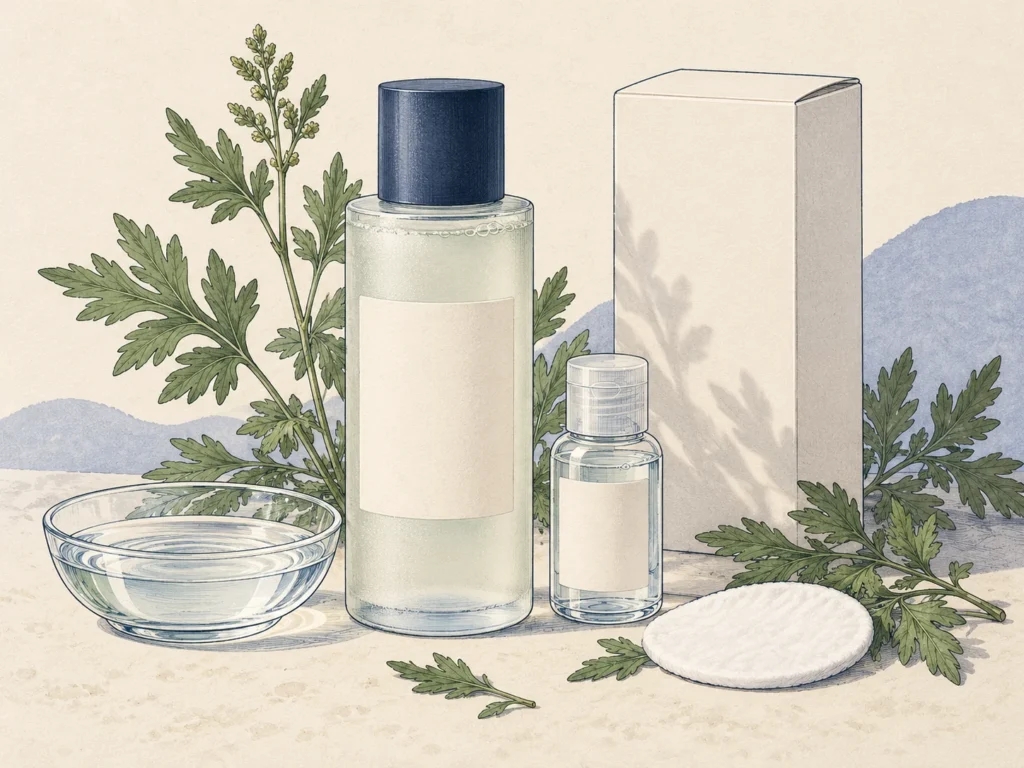
Mugwort toner is a finished liquid skincare product containing a mugwort-derived ingredient. Compare the complete formula, intended purpose, texture, directions and packaging. A mugwort toner is not automatically an exfoliant, and its name does not establish that it is stronger or weaker than a mugwort essence.
You may be comparing two retail bottles or considering a toner for your own brand. In both cases, the useful starting point is the exact product, not the ingredient trend alone.
This guide explains what to look for on the label, how the formats differ and which questions a small business should ask before arranging samples or private label production.
What is mugwort toner?
It is a toner formulation featuring a mugwort-derived ingredient. The botanical may be one component among water, humectants, preservatives and other ingredients. The sales name does not define one standardized recipe.
Check the botanical ingredient declaration and the rest of the formula. Different products can use different Artemisia ingredients and supporting components. A similar name or green label does not establish an equivalent formula.
For a particular branded toner, review the current product and packaging for your market. An older review may describe another version, and a similar-looking supplier sample is not proof of a matching formulation.
Mugwort toner vs. essence, serum and toner pads
| Format | What to check | What not to assume |
|---|---|---|
| Liquid mugwort toner | Purpose, texture, ingredients and dispensing | That every toner exfoliates or performs the same function |
| Mugwort essence | Finished formula and the role it would have in a routine | That it must contain more botanical material than a toner |
| Mugwort serum | Formula, supported claims and application directions | That “serum” is a universal measure of concentration |
| Mugwort toner pads | Liquid formula, pad material, fill and container | That pads are identical to a separately bottled toner |
The categories can overlap. Compare what each product is intended to do and whether it duplicates something you already use. Our mugwort essence guide explains the related product category.
Is mugwort toner hydrating or exfoliating?
Read the specific formulation and claims. A toner may be positioned around hydration or skin feel, while another formula may include exfoliating ingredients. The word “mugwort” does not settle the distinction.
For a retail purchase, check the complete ingredient list and directions. Do not infer exfoliation from a botanical name or assume that every watery product is interchangeable.
For a brand, decide the intended cosmetic purpose before asking a manufacturer to select a formula. A brief that simply says “a mugwort toner like the popular one” leaves too much unresolved.
How should you read the ingredient list?
Identify the named mugwort ingredient, then review the whole formula. Other components influence texture, scent, preservation and the way the finished product feels. If you avoid a particular ingredient, use the current full list rather than a short promotional summary.
Ask what any botanical percentage refers to. A percentage of a prepared extract is not automatically a percentage of dry plant solids or a standardized measure of performance. A high number on the front label needs context.
A short ingredient list is not a guarantee of suitability. Equally, a longer list is not automatically a defect. The useful question is whether the complete formulation and its supporting information fit the intended product.
What texture and dispensing differences matter?
Compare watery, more viscous and other formats according to the actual formula. Note how the product pours or dispenses, whether the proposed closure controls the amount and how the pack behaves during normal handling.
If a product is designed to separate or requires shaking, its directions and sample behavior should make that clear. Unexpected changes should be raised with the supplier rather than dismissed because the ingredients are botanical.
For a sample comparison, use a simple record: product version, appearance, odor, dispensing, packaging condition and observations during the intended evaluation. Keep personal preference separate from defects or agreed acceptance points.
How should a new toner fit into a routine?
Follow the directions for that specific product. There is no universal number of layers, amount or frequency that applies to every mugwort toner. Adding more liquid is not automatically more useful.
Test a new skincare product on a small area before wider use and stop if irritation occurs. If the formula includes ingredients that overlap with other products in your routine, consider that whole routine rather than judging the toner in isolation.
For business sample reviews, favorable feedback from a few people is not a substitute for appropriate finished-product assessment. Keep formulation and suitability questions with the relevant qualified provider.
What should a small brand specify?
Start with the destination, intended customer, purpose, texture, pack size, approximate quantity and target price range. Establish whether an existing formula is suitable or whether a development project is required.
| Area | Information to agree |
|---|---|
| Formula | Full ingredient information, botanical specification and intended claims |
| Format | Liquid, spray or pads; texture, dispensing and directions |
| Packaging | Container, closure, liner, seal, label and transport protection |
| Product information | Relevant safety, stability, microbiological and packaging-compatibility information for review |
| Commercial terms | Product and printing minimums, sample approval, lead time and change control |
Ask who makes the actual product and which steps are carried out elsewhere. A raw botanical supplier should not automatically be treated as a suitable finished-skincare manufacturer.
What should you approve in a packaging sample?
Approve the product and container together. A bottle sample that has only held water does not establish compatibility with the toner formula. Ask which information supports the proposed pack.
Review dispensing, leakage, closure security, label application and the final presentation. For pads, include the carrier material, count, liquid distribution and container closure. Record the exact approved version.
Discuss ingredient declaration, directions, batch coding and required destination wording before printing. Product and printed-packaging minimums may differ; compare those costs clearly for a first order.
How can GCB support the sourcing work?
GCB can help translate a clear product brief into supplier discussions, compare manufacturer options and coordinate samples and private label packaging. We agree which supplier checks and production tasks are included.
Start with a defined product and an achievable sample stage. Our Samples & MOQ guide explains how a small business can discuss the first step without assuming a universal minimum quantity.
Frequently asked questions
Is mugwort toner the same as mugwort essence?
Their positioning can overlap, but the actual formulations may differ. Compare ingredients, purpose, texture and directions rather than relying on the names.
Does every mugwort toner exfoliate?
No. Check the formula and intended purpose. Mugwort in the product name does not establish that it contains an exfoliating formulation.
Does a high extract percentage make a toner better?
Not automatically. Establish what the percentage measures and assess the finished formula and supporting information.
Are mugwort toner pads identical to liquid toner?
Do not assume so. Pads include a carrier, liquid and container system. Compare the actual products, not only the shared botanical name.
Can a small brand customize bottles and labels?
Yes, subject to supplier capability and minimums. Confirm the formula, compatible container, dispensing, printing and approval process together.
What information should I send for a quotation?
Send your destination, intended product purpose, format, pack size, approximate quantity, ingredient preferences and packaging idea. Say whether you need an existing formula or development work.
Related guidance: OEM & Private Label · Samples & MOQ · Pricing & Payment
Updated October 18, 2026.
About Global China Bridge
Global China Bridge is a China-based sourcing and product-development service company helping overseas entrepreneurs, small brands, retailers and other small businesses work with Chinese manufacturers. We support supplier searches, factory verification, samples, OEM and private label packaging, production follow-up, quality checks and shipping coordination.
Planning a mugwort toner project? Tell us your target country, product requirements, approximate quantity and packaging idea. Small orders are welcome to discuss. We start with a free conversation, then agree a clear scope and fee for any work.