
By Bryan · Global China Bridge
For low-MOQ custom 925 silver jewelry in China, confirm the design route, quantity by variant, material and finish requirements, sampling scope and approval process before asking for a final price. An established design with limited changes and a new design requiring development can have very different starting conditions. A supplier's low minimum is useful only when it applies to the jewelry you actually intend to order.
For a small jewelry brand or designer, a first batch should help bring a considered design into a product customers can wear. The important questions often sit between the sketch and the quotation: how the piece will be constructed, which details need revision and what the approved sample must demonstrate.
Choose the route before discussing minimum quantity
| Route | What to establish | Possible effect on a first order |
|---|---|---|
| Established design with branding or packing changes | Available construction, material specification and permitted changes | May avoid some design work, but finishing and packaging minimums still need checking |
| Modification of an existing design | Which dimensions, findings, stones or finishes change | Some changes may require new models, components or process trials |
| Original custom design | Design files, structure, development work and sample revisions | Development costs and decisions may need resolving before bulk quantity is practical |
These routes describe the work, not guaranteed production minimums. When speaking to a low MOQ jewelry manufacturer, ask which route its advertised offer covers. GCB helps buyers find and coordinate suitable manufacturers; we do not describe every workshop's capability as our own manufacturing operation.
Make the 925 silver requirement specific
Sterling silver is associated with a silver fineness of 925 parts per thousand, or 92.5%. GIA discusses this composition in its overview of silver jewelry. That material description does not establish the composition or suitability of an individual item supplied to you.
Specify the intended material and ask how the supplier will demonstrate it. Identify the components covered: the main piece, chain, clasp, posts, backs and any other findings. If parts use different materials for functional reasons, understand and document the arrangement before approval.
Also confirm marking and any testing or documentation needed for the destination market and product category. A “925” stamp is not a substitute for appropriate evidence. Do not assume a material claim settles requirements for every coating, component or intended wearer.
Turn the design into requirements a workshop can discuss
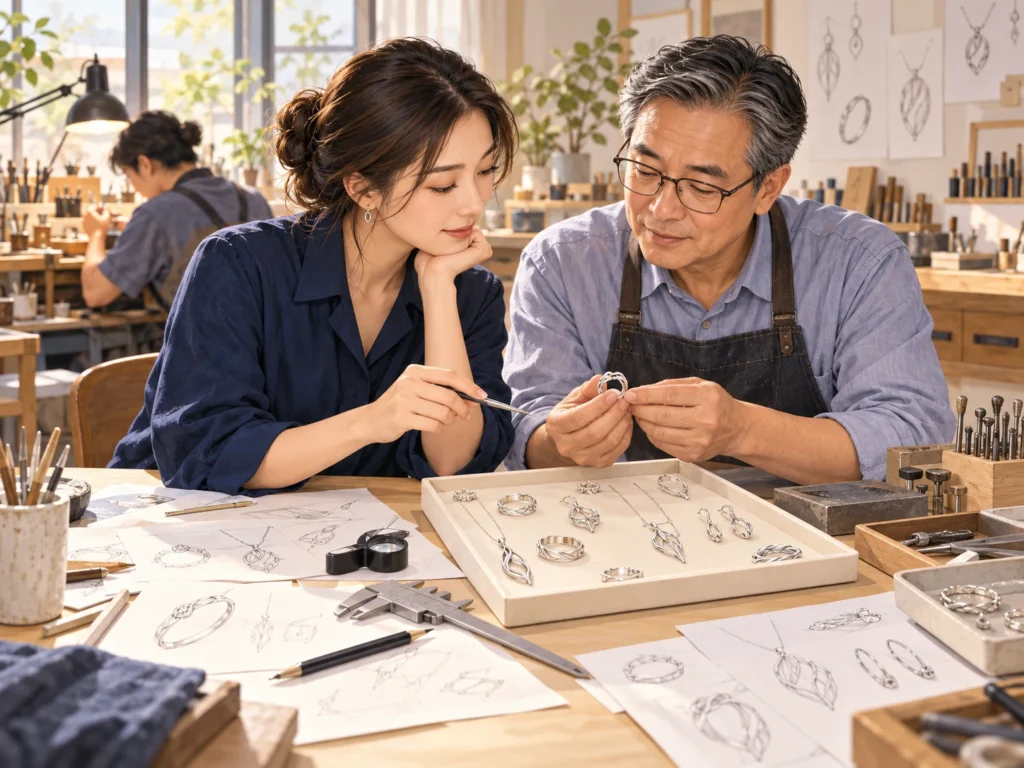
Send clear views or a reference sample, dimensions, intended use and the details that must be preserved. Explain what a photograph cannot show, such as weight preference, chain movement, a concealed joint or how a ring should sit on the hand.
- Overall dimensions, ring sizes and relevant thicknesses
- Construction, joints, clasp or attachment details
- Surface finish, texture and color references
- Stones or other inserts, including size and setting expectations where applicable
- Brand marking, packaging and presentation requirements
- Estimated quantity by style, size and finish
If you do not yet have a production-ready drawing, say so. Ask what preparation the manufacturer needs and how design or modeling work would be quoted. A supplier should not have to guess the structure from one attractive image.
Ask how MOQ is calculated for the collection
Confirm whether the minimum applies per design, size, finish or component order. Ask whether different sizes can share a production commitment and whether additional finishes create separate minimums. The answer depends on the product and process.
For example, a hypothetical supplier may permit several ring sizes within one style quantity while requiring a separate finishing run for a second color. Another workshop may use a different arrangement. This is an illustration of a question to ask, not a standard MOQ or a GCB offer.
Review the collection as a whole. A few designs, each with several sizes and finishes, can create more variants than a first launch can comfortably manage. Keep the combinations that are necessary to test your market and consider postponing the rest.
Separate sampling costs from production assumptions
Ask which fees cover design preparation, a physical sample, model or tooling work, revisions, finishing and delivery. Clarify what changes are included and what happens when the brief changes after work begins.
If tooling, models or digital files are being created, agree access, custody and any future reuse arrangements in writing. Do not assume a sample payment automatically settles those terms. A repeat order should not depend on an understanding neither side has recorded.
Also ask which product assumptions the quotation uses, such as the approved design, weight basis where applicable, components and finish. Obtain an updated quotation when those assumptions change. Our sample-cost guide explains why the first sample and the production price answer different questions.
Use the sample to improve the product, not only approve its appearance
A sample review should consider the piece in use. Check proportions, edge comfort, movement, closure, attachment points and the consistency of the intended finish. Review dimensions against the agreed reference instead of relying only on photographs.
Ask the workshop to explain a proposed process improvement in terms of the design. Does it strengthen an attachment, improve access for polishing or make the finish more consistent? Review the actual trade-off before approving it: a more practical construction can still change the appearance you intended.
Record each requested change with a photograph, description and version. Distinguish a change essential to approval from a possible idea for a later collection. Uncontrolled revisions can make it difficult to know which sample the factory should reproduce.
What our completed 925 silver project illustrates
An overseas jewelry design company asked GCB to help find a suitable Chinese manufacturer for custom 925 silver products. Our involvement included an on-site factory visit, detailed factory discussions and practical suggestions for process improvements during sampling.
The project moved beyond a factory introduction: we helped the buyer develop samples and improve the product's workmanship, drawing on jewelry experience. It also helped reduce unnecessary development work and time. We do not attach an invented savings percentage, production minimum or delivery period to that result.
Read the full 925 silver jewelry development story. It shows the kind of coordination involved; the scope and feasibility of another design still need their own discussion.
Connect sample approval to the first production batch
Before ordering, identify the approved sample and current specification. Confirm which changes are closed, the quantity by variant, the material and finish requirements, packaging and the checking plan.
For details difficult to judge in photographs, decide whether physical reference samples or specialist review are needed. Agree how deviations and proposed substitutions will be raised before they enter production.
Discuss packaging as part of the product. Separate items, closures and presentation materials may need different handling. For a finish-sensitive piece, clarify how it will be protected through packing and transport rather than choosing packaging only for its appearance.
Bryan's view: a workable first collection needs careful decisions
I would rather understand a few designs properly than rush a large assortment into sampling. Jewelry experience can help identify questions early, but the factory must still confirm the process and the buyer must approve the result. Good coordination connects those decisions instead of allowing each revision to start a new conversation.
You can begin by discussing manufacturer selection, customization support or a focused sampling task.
Meet Bryan and see how we work
I'm Bryan, the founder of Global China Bridge, based in Beijing. I help overseas entrepreneurs and small businesses clarify and coordinate product and manufacturing work in China.
The work you entrust to us deserves careful questions, clear communication and follow-through. We begin with the task your business needs now, and discuss specialist support when the product requires it.
Meet Bryan and read our story · Explore our sourcing stories
Questions buyers often ask
What is the minimum order for custom 925 silver jewelry?
There is no universal minimum. The design, sizes, components, finish and workshop arrangement matter. Ask how the minimum applies to your exact collection rather than relying on an advertised starting figure.
Can I start with a sketch rather than a CAD file?
It can be a starting point for discussion. The manufacturer may need additional dimensions, views or modeling work before producing a meaningful sample. Agree that preparation separately.
Does a 925 stamp prove the material?
The stamp states a claim; it is not independent confirmation. Agree what evidence or testing is appropriate for your product, components and destination requirements.
Can I mix ring sizes and finishes to meet MOQ?
Possibly, but the arrangement is supplier- and process-specific. Confirm size allocation, finishing minimums and any separate component or packaging commitments.
Should I approve the sample from photographs?
Photographs can support review but may not reveal comfort, closure behavior, weight or subtle finish differences. Decide which details require physical examination before production approval.
Is GCB a silver jewelry factory?
GCB provides manufacturer sourcing and project coordination. Our jewelry experience supports factory discussions and sampling, while the selected manufacturer performs the agreed production work.
Tell Bryan about the silver jewelry you want to develop
Send your sketch, reference sample or product images, estimated quantity by design and intended market. Explain which design details matter most to you.
The first introductory conversation is free. If there is useful paid work to undertake, we agree its scope, deliverables and fee before starting. Relevant third-party costs are discussed separately.
Prefer email? Write to service@globalchinabridge.com.
Continue with your next question
Updated: October 16, 2026