
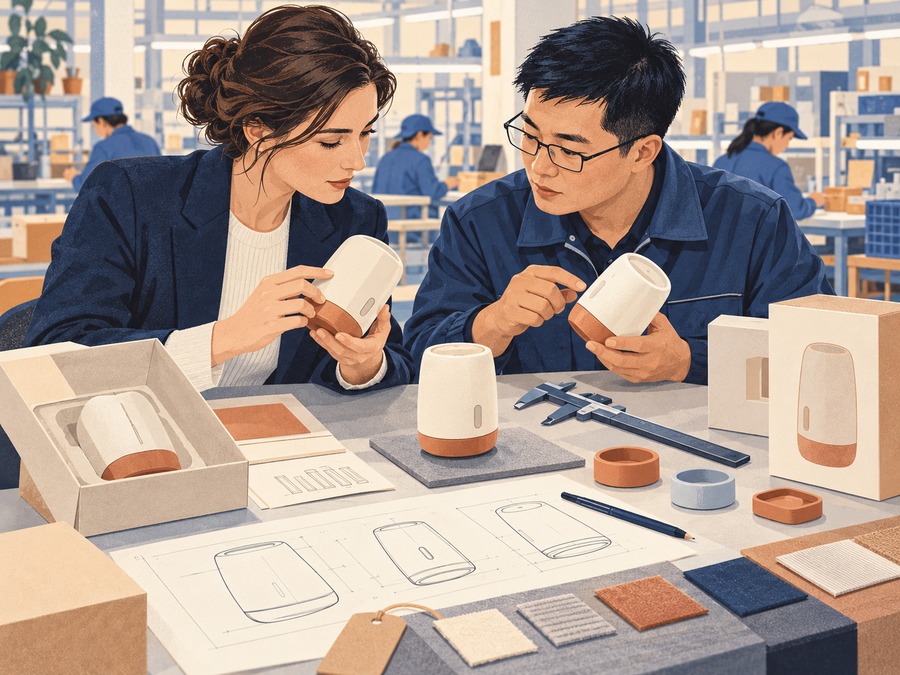
Before approving a product sample from China, confirm what it represents, check it against your requirements, and record the exact version you accept. Then clarify how that version will be reproduced in bulk. A pleasing sample is useful evidence, but it does not by itself establish consistent production quality.
Your sample has arrived. The product looks close to what you imagined, the logo is in place, and you are eager to start selling. The factory is asking whether it can begin production.
Before you reply “approved,” take a little time to identify what you are approving. Does this sample use the intended material? Was it made using the proposed production process? Is the packaging final? Are there small issues you expect the factory to correct without having discussed them?
These questions protect the work you have already done. Clear approval gives the factory a usable reference and gives you something concrete to check when the batch is ready.
First, ask what kind of sample you received
A stock sample can show an existing product's construction and finish. A development prototype may help you check an idea while using temporary materials or a different process. A pre-production sample should reflect the agreed production arrangement, but you still need to confirm which elements are final.
Ask the supplier to identify the sample's purpose, materials, process, and remaining differences from the intended order. If it was hand-finished, ask which steps will change in bulk production and how the result will be controlled.
You may approve a prototype's shape while leaving its surface finish unresolved. That is a useful decision if recorded clearly. It is not the same as approving the whole product for manufacture.
Check the sample as your customer will use it
Start with the intended use. Handle the product, assemble it if required, and check whether its important functions work under appropriate conditions. Think about what would disappoint your customer after the first impression.
For a desk accessory, that might be stability, fit, finish, and protection in transit. For a sewn product, it might include seam construction, dimensions, and fastening. The checking method should fit the product rather than copying a generic list.
Record measurements and observations against requirements agreed with the supplier. Words such as “premium” or “strong” need to be translated into characteristics that can be examined or tested. If a requirement involves safety, material composition, or regulated performance, arrange suitable specialist assessment; personal handling cannot establish those properties.
Review the product information, accessories, and packaging too. A good main item with the wrong instructions or missing component may still create problems for the buyer.
Separate acceptable details from changes still required
Do not leave the supplier to interpret a message such as “looks good, just improve the quality.” Identify each issue with photographs, a location on the product, and an agreed requirement where possible.
Explain whether you are asking for a correction or proposing a new requirement. A new material, tighter tolerance, or different packaging may affect cost, tooling, minimum quantity, testing, and delivery. Ask for those effects before accepting the change.
When a revision is needed, agree on who will prepare it and when you will review it. Check the revised sample against the earlier concern. A new photograph alone may not answer a question about fit, feel, or function.
Give the approved version an identity
Assign the sample a reference number or clear version and date. Link it to the current drawing, material specification, artwork, and packing instructions. Keep a physical reference where suitable, and agree on a corresponding factory reference or equivalent arrangement.
If you and the supplier retain separate samples, make sure they represent the same approved version. Record any differences rather than assuming they match.
Some characteristics need written limits or test methods as well as a physical sample. A reference object can help explain appearance, but it cannot reliably define every dimension, internal component, or material property.
| Approval item | What to record | Why it matters |
|---|---|---|
| Sample identity | Version, date, supplier, and product variant. | Prevents an earlier sample becoming the production reference. |
| Product requirements | Current drawings, materials, important limits, and test methods. | Gives the factory measurable instructions. |
| Open issues | Changes required, owners, and evidence needed. | Separates partial approval from production release. |
| Packaging | Protection, accessories, labels, and pack quantities. | Connects the approved item to the goods your customer receives. |
| Change control | Which changes need written buyer approval. | Prevents informal substitutions after sample acceptance. |
Connect sample approval to the production floor
Ask how the factory will pass the approved requirements to production staff and quality personnel. Where is the reference kept? How will the first production pieces be checked? Who confirms that materials and settings match the plan?
If the difference between the sample method and the production method creates uncertainty, an early production check or suitable pilot run may help. The right step depends on the product and the risk, rather than a fixed rule that every order needs the same arrangement.
Sample approval does not mean that every later unit will be identical. Agree on appropriate production checks and a plan for inspecting the eventual batch. A factory visit can help connect your approval to actual work, especially when an important change has not reached the workshop.
For example, an approved shape may still leave packaging unresolved
Imagine you receive a branded organizer sample and approve its shape and assembly. The supplier sent it in a plain protective box. You intend to sell it in a printed retail box with several accessories.
If you simply write “sample approved,” production may begin while the retail pack remains undefined. Its dimensions could affect carton quantities, protection, cost, and the shipment schedule.
This is an illustrative scenario, not a reported Global China Bridge case. The practical response is to record approval of the product features, identify packaging as an open item, and agree on what must be confirmed before the relevant work begins.
If sampling keeps going in circles, identify the unresolved decision
Sometimes a supplier keeps revising a sample without reaching a clear result. Check whether the problem is a missing specification, a process limit, a communication gap, or a new request being added each time.
Bring the current version and the change list into one discussion. Ask the relevant technical person what can be achieved and what trade-offs are involved. You may need to simplify the design, allow a different process, or consider another supplier.
At Global China Bridge, we can discuss a defined sample-coordination task: clarifying feedback, tracking revisions, or following up on production questions. Relevant testing or specialist review may be separate. Agree on the scope and fees before paid work begins.
Meet Bryan and understand how we work
I'm Bryan, the founder of Global China Bridge, based in Beijing. I help overseas entrepreneurs and small businesses explore and coordinate product and manufacturing work in China.
Helping your business move forward gives ours a foundation to grow. Work you entrust to us deserves careful attention, clear communication, and follow-up on the tasks we agree to undertake.
Meet Bryan
Read why I started Global China Bridge and how I approach a client's plans.
Meet Bryan and read our story →Explore Sourcing Stories
Read about practical questions and decisions in our sourcing work.
Read our sourcing stories →Tell me what the sample has not settled
Share the product, expected quantity, destination market, and the feature or revision still causing uncertainty. Keep confidential designs and payment details out of the first message.
The introductory conversation is free, with no obligation to proceed. If useful work is possible, we can agree on a small, clearly defined task and its cost before discussing a wider commitment.
Discuss your sample with Bryan
Prefer email? Write to service@globalchinabridge.com.
Questions buyers often ask
Is a good sample enough to approve an order?
It supports the decision, but you still need clear specifications, an agreed production arrangement, and appropriate checking of the eventual batch.
Can I approve only part of a sample?
Yes, if the approved features and unresolved items are clearly recorded, with an explicit decision about which work may begin.
Should the factory keep an approved sample?
An appropriate factory reference can help. Agree on its identity and connection to the written requirements, and confirm that any retained counterparts match.
Can photographs replace a physical sample?
They can document appearance and changes, but may not settle questions about dimensions, material, feel, fit, or performance.
What if a revised sample still has the same defect?
Keep the issue open. Ask what caused it, what changed, and what evidence supports the proposed correction before approving the relevant feature.
Does changing a sample affect the price?
It can. Ask about materials, tooling, quantity, testing, packaging, and schedule implications before approving a change.
Does sample approval confirm product compliance?
No. Market-specific safety or regulatory requirements may require separate expert assessment and testing.
Can you help coordinate sample revisions?
We can discuss the product and the unresolved decisions first, then agree on a suitable task, fees, and any specialist support required.
Continue planning your purchase
Updated: October 5, 2026