
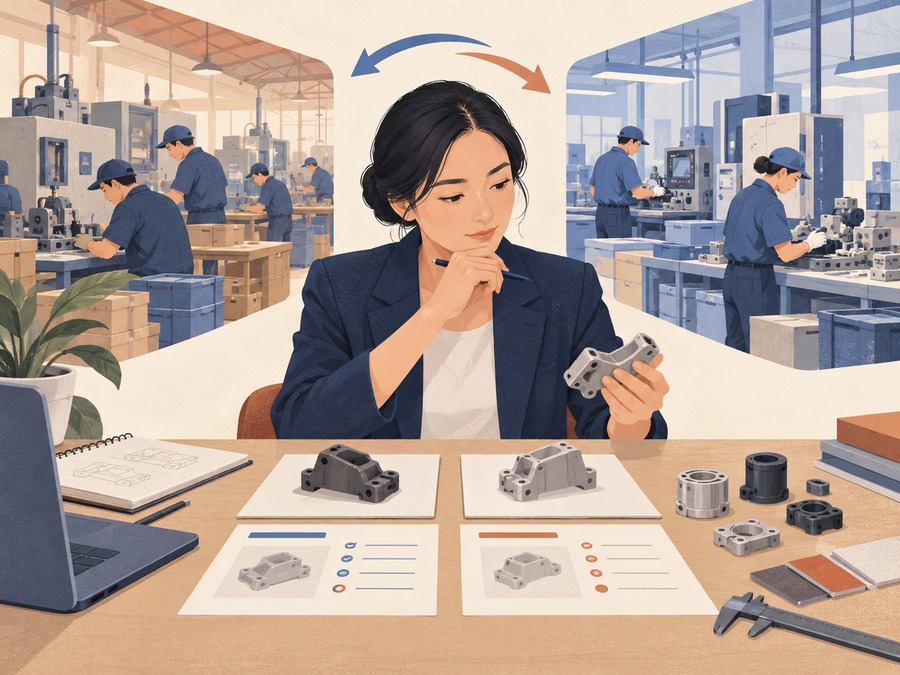
Consider changing your Chinese supplier when important problems remain unresolved, recur despite agreed corrections, or show that the supplier no longer fits your needs. Before switching, compare a credible recovery plan with a verified alternative and account for samples, tooling, stock, timing, and handover.
Another delivery has slipped, the finish varies again, or a question has gone unanswered for weeks. You are wondering whether you should give the supplier another chance or begin elsewhere.
You need a decision that improves the business. A lower quotation from a new factory may be appealing, but it does not tell you how long the transition will take or whether the replacement can reproduce the product properly.
Define the problem and its business impact
Write down what happened, which orders were affected, and the consequences for customers, cash, stock, and scheduling. Compare the result with the agreed requirement, not only with an expectation that was never communicated.
Separate an isolated issue from a pattern. Several small problems may reveal a common weakness, such as poor change control or unreliable updates. A major unresolved issue may deserve action even without a long history.
Judge the response as carefully as the defect
Does the supplier investigate the cause, identify affected goods, propose a practical correction, and verify the result? Does it report new risks early? A factory can make a mistake and still be a useful partner if it handles the problem competently.
Repeated assurances without an owner, deadline, or evidence leave you exposed. Changing explanations or unapproved substitutions require closer scrutiny. You do not have to establish dishonest intent to conclude that the arrangement is unsuitable.
Check whether your needs have changed
The supplier that handled an early standard product may not be suited to a more demanding design, larger volume, or tighter schedule. Equally, a large factory may give little attention to a small, mixed order.
Discuss the requirements that now matter. Some gaps can be addressed through different arrangements; others are fundamental capability or fit issues. Avoid treating the supplier’s historic success as proof of readiness for new work.
Ask for a bounded recovery plan if recovery is realistic
Where appropriate, agree on a specific correction and review point. State the requirement, evidence, responsible person, and what you will decide after the result is known.
A recovery period should serve a purpose. Repeated extensions without meaningful progress consume time you may need for alternatives. Essential safety, compliance, or other serious concerns may require immediate specialist attention rather than a routine trial period.
Verify the alternative before relying on it
Send the current specification and clarify the proposed production arrangement. Review suitable samples, relevant capability, capacity, quality practices, and delivery assumptions. A helpful salesperson and lower price are an introduction, not qualification.
Independent checking or a site visit may help with important gaps. QIMA describes manufacturing audits as assessment of capacity, equipment, quality systems, and workflows. Choose checking relevant to your product; a generic visit cannot establish every technical requirement.
| Decision factor | Current supplier | Potential replacement |
|---|---|---|
| Requirements | Can the gap be corrected and verified? | Can the new process meet the current specification? |
| Timing | Is recovery supported by a workable plan? | How long will samples, qualification, and setup take? |
| Costs | What does continued failure cost? | What are the transition and first-order charges? |
| Responsibility | Does follow-up lead to completed action? | Are roles, approval, and release arrangements clear? |
Plan the handover of the product, not just the order
Identify current drawings, sample references, artwork, software where relevant, tooling, packaging stock, and work in progress. Clarify ownership and access under your agreements before assuming anything can be transferred.
Tooling used at one site may need adjustment or may not suit another process. Obtain relevant technical advice and review the cost and timing. Confirm what happens to remaining stock and outstanding obligations at the current supplier.
For example, a cheaper replacement may still need qualification
Imagine your current supplier repeatedly misses the agreed finish. A second factory offers a lower price and says it can start quickly. This is an illustrative scenario, not a reported Global China Bridge case.
Sample review shows that the second factory uses a different finishing process. You can now examine whether it meets your needs before committing. At the same time, ask whether the current factory has a verifiable correction. Compare the two practical paths rather than deciding on frustration or price alone.
Choose a transition your business can absorb
Where workable, a limited qualification order or staged handover may reduce uncertainty. It also creates additional coordination and stock costs. Assess the total exposure rather than assuming that using two suppliers automatically reduces risk.
At Global China Bridge, we can discuss clarifying the current problem, exploring alternatives, and coordinating a defined comparison or qualification task. We are not a substitute for technical or legal advice about your obligations. Agree on the task, fees, and separate charges before paid work begins.
Meet Bryan and understand how we work
I'm Bryan, the founder of Global China Bridge, based in Beijing. I help overseas entrepreneurs and small businesses explore and coordinate product and manufacturing work in China.
Helping your business move forward gives ours a foundation to grow. Work you entrust to us deserves careful attention, clear communication, and follow-up on the tasks we agree to undertake.
Meet Bryan
Read why I started Global China Bridge and how I approach a client's plans.
Meet Bryan and read our story →Explore Sourcing Stories
Read about practical questions and decisions in our sourcing work.
Read our sourcing stories →Start with the question affecting your next decision
Share the product, expected quantity, destination market, and what you need to clarify. Keep confidential designs and payment details out of the first message.
The introductory conversation is free, with no obligation to proceed. If useful work is possible, we can agree on a small, clearly defined task and its cost first.
Discuss your supplier decision with Bryan
Prefer email? Write to service@globalchinabridge.com.
Questions buyers often ask
Is one late order enough reason to change?
It depends on impact, cause, response, and fit. Look at evidence rather than applying a fixed number of incidents.
Should I stay if the supplier offers a discount?
A discount does not resolve capability or process problems. Evaluate whether the correction actually addresses the requirement.
Is the lowest-price replacement the best option?
Not necessarily. Check scope, capability, qualification time, responsibilities, and overall transition costs.
Can I transfer my moulds automatically?
Do not assume so. Review ownership, access, contractual arrangements, and technical suitability for the new site.
Should I test the new supplier with a small order?
A suitable qualification order can provide evidence, but must represent the intended production arrangement and have clear criteria.
Does using two factories always reduce risk?
No. It can add coordination, qualification, stock, and consistency issues. Evaluate whether it addresses a specific dependency.
When should I stop extending a recovery deadline?
Use the agreed evidence and review points. If essential questions remain unresolved, reassess the commitment and alternatives.
Can you help find an alternative without ending the current relationship?
We can discuss a defined research or comparison task. Your supplier commitments and transition decisions remain subject to your agreements.
Continue planning your purchase
Updated: October 5, 2026