
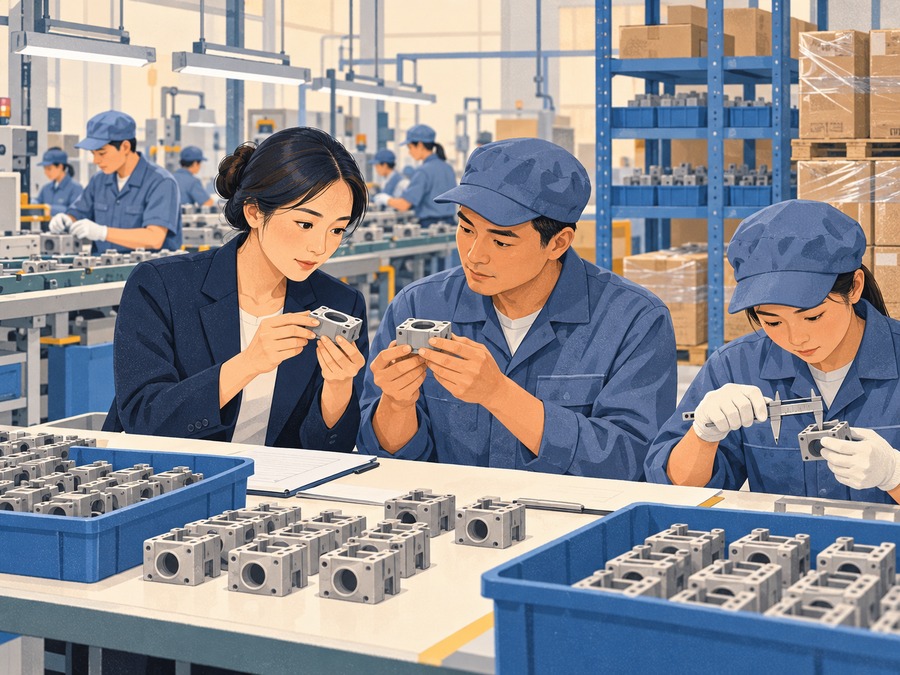
During a factory visit in China, follow the actual work behind your product: the workshop, relevant production lines, ordinary finished goods, quality checks, delivery planning, and storage. Look closely at how people handle materials and problems. A large building and a polished presentation give you only part of the picture.
The supplier has sent you photographs of its factory. You can see machines, workers, and cartons ready for shipment. Everything looks organized, and the salesperson says your order will receive the same attention.
What you still need to understand is how that attention shows up in everyday production. Will the finish stay consistent across the batch? Will a worker stop when a component is wrong? Will your goods be protected while waiting to ship? Is the promised delivery date backed by a workable plan?
A useful visit takes those questions into the workshop. You should leave with specific observations that help you decide whether to proceed and what still needs attention.
Plan the visit around your product and your decision
Before arranging a visit, write down the requirements that matter to your order. Bring the current specification, approved sample if available, expected quantity, packaging requirements, and target schedule. Identify the features that would cause complaints or make the product unsuitable for your customers.
Agree on access to the relevant workshop, production staff, quality personnel, and storage areas. Ask whether a similar product will be running that day. If your process is not operating, the visit cannot establish how it performs in normal production; record that gap and arrange a suitable follow-up.
Respect confidentiality, worker privacy, and site safety rules. Agree on photographs and document access beforehand. Where the product requires specialist knowledge, select someone capable of assessing that process rather than relying on a general business tour.
Look beyond the factory entrance
Check that the site you visit is the proposed production location and establish which business operates it. Understand its relationship to the company quoting your order. A shared industrial building or rented workshop can be legitimate, but you need clarity about who is doing the work.
Then look at the usable working space. Can materials move through the workshop without being mixed or damaged? Is there room for work in progress, inspection, and packing? Are relevant machines in use, waiting for maintenance, or simply on display?
A modern facade does not answer these questions. An older building may contain a well-managed operation. Judge the conditions relevant to your product, including cleanliness, protection, and the way work moves between departments.
Follow a product through the production line
Ask the supervisor to walk you through an actual job, from incoming materials to finished goods. Compare that route with the process described in the quotation and technical discussions.
At each important stage, ask what is being done, what can go wrong, and how the operator knows the result is acceptable. Check whether the workstation has the correct drawing, sample, or instruction revision. If the specification changes, how does the updated instruction reach the people doing the work?
Look for queues between operations. A line may appear busy while parts wait several days for finishing, testing, or packing. Ask which operation limits output and how your order would fit around existing commitments.
If coating, printing, tooling, or another critical step is outsourced, establish where it takes place and who checks it. Visiting the assembly workshop leaves that external process unverified unless it is included in the checking scope.
Examine ordinary finished products, not just display samples
The showroom sample shows what the factory can present. Everyday finished goods help you assess what it is actually producing.
With permission, examine pieces from a clearly identified current batch. Avoid relying only on items the salesperson has selected in advance. Compare several pieces against the relevant specification or reference sample and record where they came from. A few observations are useful, but they are not a statistically representative batch inspection.
The details depend on the product. You might examine surface scratches, sharp edges, seams, alignment, printing consistency, component fit, or how a moving part feels. Look at hidden areas and packaging as well as the front-facing appearance.
For measurements or functional checks, use suitable equipment and a defined method. Ask whether the measuring tools are appropriate and have current calibration or verification where needed. Visual inspection alone cannot establish material composition, electrical safety, or other requirements that need testing.
If defects are visible, ask how the factory classifies and handles them. The response matters: can it trace the affected work, explain the cause, and show how correction is checked?
Watch how carefully workers carry out the job
You cannot assess responsibility from a worker's expression or a few seconds at a workstation. Observe the actions that protect the product.
Does the operator check the first piece before continuing? Are sensitive surfaces protected? Are small parts kept in identified containers? When something looks wrong, is it separated and reported, or passed to the next operation?
Ask how a new worker learns the task and who confirms that they can perform it correctly. If people are transferred between jobs, how are they briefed on the different requirements? Careful work depends partly on training, clear instructions, usable tools, and supervision.
Watch how the supervisor responds to a question or defect. Does someone investigate and take ownership? Does the explanation reach the person who can change the process? Observe more than one relevant stage so that a single well-prepared workstation does not shape the entire judgment.
Small actions reveal useful evidence: keeping finished pieces away from rough surfaces, checking a setting after adjustment, or stopping a repeated defect before more units are made.
Check whether quality management is used on the floor
A quality manual describes a system. During the visit, connect that system to a current job.
Ask to see the incoming-material checks, in-process inspection records, and final release records relevant to the product. Who performed the check? Against which requirement? What was the result, and what action followed a failure?
Then compare the records with the workshop. If the sheet says a dimension is checked at regular intervals, ask the operator to explain the check and show the tool. If rejected pieces require a separate area, find that area and see how items are identified.
Ask how reworked goods are inspected again before release. Find out who may approve a material substitution or accept a deviation. A worker should not have to guess whether an unfamiliar defect is acceptable.
Where a supplier presents certification, verify its authenticity, current status, and scope separately. The certificate does not replace checking how the relevant production process operates or inspecting your order.
Check delivery safeguards against the current workload
Ask the production manager to explain how your proposed delivery date would be achieved. A useful answer connects material availability, machine time, staffing, outsourced work, inspection, and packing.
Check which materials are already available, which still need ordering, and whether supplier lead times have been confirmed. Ask where your job sits in the production schedule and what happens if an earlier order runs late.
Discuss maintenance and backup arrangements for equipment that could stop the whole job. If a critical process relies on one external provider, ask how that risk is managed. More machines do not automatically provide backup if they cannot perform the required operation.
Agree on milestones and evidence for progress updates. Clarify when the lead time begins and whether the date means production completion, goods ready for collection, or dispatch. Freight transit is a separate part of the schedule.
Recent delivery records can add context where access is permitted, but past performance does not promise your deadline. Confirm obligations and any agreed remedies in writing, and follow progress after the order starts.
Walk through the warehouse and packing area
A product can be made correctly and damaged, mixed, or shipped incorrectly afterward. Storage deserves the same attention as production.
Check how raw materials, work in progress, finished goods, rejected items, and goods awaiting inspection are distinguished. Can staff identify the order, batch, version, and release status without relying on memory?
Look at whether items are protected from moisture, dust, scratches, excessive stacking, or other risks relevant to the product. Temperature-sensitive, perishable, chemical, or electronic goods may require specialist storage conditions and controls.
Ask how stock is issued to production and how older or expiry-sensitive materials are managed where applicable. Check whether inventory records correspond to a small selection of physical stock, within the agreed access.
In the packing area, compare the actual packing method with your requirements. Are product variants separated? Are labels and carton quantities checked? Who confirms that the correct goods are released for shipment?
A tidy warehouse is encouraging. Traceable stock, appropriate protection, and a clear release process provide stronger evidence that your order will leave correctly.
Use small details to ask better follow-up questions
| What you observe | What to ask next | Why it matters |
|---|---|---|
| Several unlabelled containers hold similar components. | How are specifications and batches distinguished? | Similar parts can be mixed even when each looks acceptable. |
| A workstation uses an older drawing. | How are revisions approved, distributed, and withdrawn? | Correct workmanship against an outdated instruction can still produce the wrong item. |
| Rejected and accepted goods share the same area. | How is status identified and accidental release prevented? | Defects need to remain controlled until a documented decision is made. |
| Finished surfaces touch rough bins or benches. | What protection is required between operations? | Handling may damage a finish after the production step is complete. |
| The production date is confirmed, but packaging is unbooked. | When will packaging arrive, and what is the fallback? | The item may be finished while the shipment remains delayed. |
These observations are prompts for investigation, not automatic verdicts. Check the explanation, its supporting evidence, and whether the risk affects your product.
For example, the packing bench may explain a quality problem
Imagine you are considering a supplier for a small batch of branded desk accessories. The showroom pieces look good, and the factory has equipment suitable for the main process.
At the packing bench, you notice finished pieces stacked directly against each other. Several have light scratches. The supervisor explains that a protective layer is normally added, but the current job is waiting for packaging materials. You also find that two similar variants are separated by position on the bench rather than by labels.
This is an illustrative scenario, not a reported Global China Bridge case. The useful finding is specific: surface protection and variant identification need clarification before your order proceeds.
You can ask for the protective method to be included in the specification, confirm packaging availability, and agree on checks before shipment. Taking a photograph of the factory entrance would not have revealed those details.
Leave with findings that support a decision
A useful visit report records the date, site, people met, processes operating, documents reviewed, and products examined. Photographs should have context and permission. Separate what was observed from what the supplier stated.
For each concern, describe the evidence, its relevance to your order, the proposed action, the responsible person, and how completion will be checked. List areas that were inaccessible or processes that were not running.
Your next step may be to proceed with conditions, request corrections and follow-up evidence, arrange specialist testing, or pause the commitment. A general statement that “the factory looks professional” gives you little basis for choosing between those options.
A visit provides evidence at a particular time. It does not replace a technical audit, product compliance assessment, or inspection of the eventual batch. Match the checking work to the decision and the risk you are taking.
If you cannot visit personally, define what someone should check for you
From overseas, you can review documents and discuss specifications. You cannot examine a surface by hand or follow a workshop problem from one station to another through an email exchange.
A suitable representative or independent inspector in China can carry out an agreed visit. Give them the product requirements and the questions affecting your decision. For specialized processes, they need relevant technical competence as well as access.
At Global China Bridge, we can discuss the uncertainty you want to resolve and whether practical coordination or appropriate on-site checking can help. The location, supplier cooperation, and expertise required affect the scope. Travel, inspection, testing, and other separate charges are clarified before paid work begins.
Meet the person helping you ask the questions
I'm Bryan, the founder of Global China Bridge, based in Beijing. I help overseas entrepreneurs and small businesses explore and coordinate product and manufacturing work in China.
I believe work you entrust to us deserves careful attention. For a factory visit, that means looking at the details relevant to your product, being clear about what was checked, and following up on the tasks we agree to undertake.
Meet Bryan
Read why I started Global China Bridge and how I approach a client's plans.
Meet Bryan and read our story →Explore Sourcing Stories
Read about practical supplier questions and decisions in our sourcing work.
Read our sourcing stories →Start with what you need to see before placing the order
Tell me about the product, expected quantity, destination market, and what still concerns you. It might be workmanship, capacity, packaging, or whether a delivery promise is realistic.
The introductory conversation is free, with no obligation to proceed. If there is useful work to do, we can agree on a small, clearly defined task and its cost first. Keep confidential designs and bank details out of your initial message.
Discuss a factory check with Bryan
Prefer email? Write to service@globalchinabridge.com.
Questions buyers often ask
What should I prepare before visiting a factory in China?
Prepare the product specification, relevant sample, order quantity, packaging requirements, schedule, and questions affecting your purchasing decision. Agree on access and the people you need to meet.
Does a large factory mean better quality?
No. Look at the relevant process, workmanship, controls, workload, and fit for your order. Building size alone does not establish those capabilities.
How can I assess whether workers take the job seriously?
Observe how they follow instructions, protect items, check results, and report defects across several relevant operations. Combine those observations with training, supervision, and records.
Should I inspect products already made for other customers?
Relevant current production can provide context if the factory permits access and respects confidentiality. Compare against that job's requirements where available; it is not approval of your future batch.
What if the line is not running during my visit?
Record that limitation. You may still review equipment and records, but arrange follow-up when the relevant process is operating if actual performance is important to your decision.
Does a factory visit guarantee delivery?
No. It helps assess the plan and current conditions. Written milestones, realistic dependencies, and production follow-up remain necessary.
Can warehouse management affect product quality?
Yes. Poor protection or unclear identification can damage goods or cause mix-ups after production. Check storage conditions, batch identification, packing, and release controls relevant to your product.
Can someone visit on my behalf?
A suitable local representative or independent inspector may do so. Agree on competence, independence, access, evidence, scope, and reporting before the visit.
Continue planning your purchase
Updated: October 5, 2026