
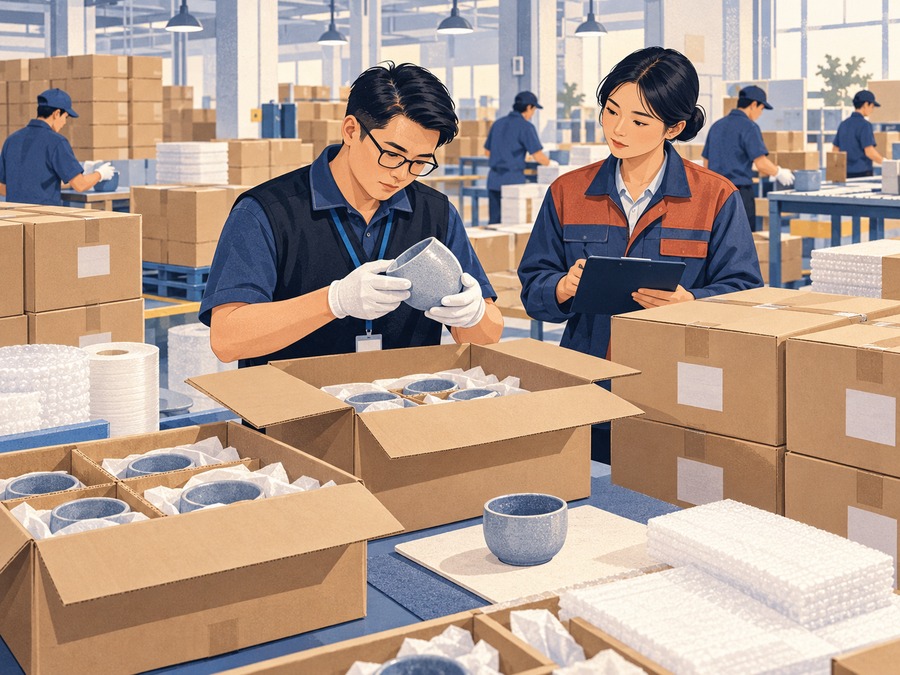
Before your order ships from China, check the finished goods against the agreed specification, sample, quantities, variants, packaging, and labels. Arrange suitable inspection while correction is still practical, review the findings, and make a clear release decision. Photographs of sealed cartons do not establish what is inside them.
The supplier says your order is ready. You receive pictures of cartons and a request to arrange collection or complete the agreed payment. After weeks of sampling and production, it feels like the difficult part is over.
Before the goods leave, take one more careful look at what you are receiving. A defect found at the factory may be repairable. The same defect discovered after international shipment can be much harder to deal with.
Confirm what ready actually means
Ask whether the full order is complete, inspected, and packed. Separate finished goods from unfinished units, items awaiting rework, and cartons still missing accessories.
If an inspection is booked, confirm that enough of the lot is ready and accessible for the agreed method. Inspection providers set readiness conditions; do not assume one percentage applies to every product or inspection. Ask what happens to goods completed after the visit.
Agree on the location, access, current specification, sample references, and time available for checking. Leave practical room for corrections and reinspection if the findings require them.
Inspect against the final requirements
Provide the inspector with the latest order details, drawings, approved sample information, artwork, packing instructions, and relevant testing requirements. Identify which requirements changed during sampling.
Important details should be measurable or clearly defined. If you require a particular finish, explain the reference and acceptance criteria. If a function must be tested, agree on the method, conditions, equipment, and result required.
The inspection cannot reliably settle a requirement nobody has defined. Clarify unresolved points before the checking starts rather than asking the inspector to guess what you would accept.
Let the checking process select goods from the lot
Ask how samples will be selected across the identified batch. A box of carefully chosen pieces supplied by the salesperson is not equivalent to an independent selection from accessible production goods.
Agree on the sampling approach, relevant defect categories, and acceptance rules with a competent provider. The choice depends on the product and risk. A fixed rule such as checking ten percent of every order may be inappropriate.
Sampling provides evidence for a lot decision within its scope. It does not inspect every unit or guarantee that no defect remains. Some characteristics may need testing, specialized inspection, or a different level of checking.
Check quality, quantity, and the product mix
Review workmanship and function alongside dimensions, materials where verifiable, accessories, and assembly. Check whether goods match the relevant approved version.
Also examine the order mix. You might have the correct total quantity but the wrong colours, sizes, or models. Compare carton records, labels, and sampled contents with the order breakdown. State how quantities were checked and any limits on that verification.
If a change was approved during production, confirm which units it applies to. Similar-looking variants need clear identification so that older and revised versions do not become mixed.
| Area | What to compare | A question worth asking |
|---|---|---|
| Product | Goods against current specifications and sample references. | Are the final changes present in ordinary production pieces? |
| Quantity and variants | Order breakdown against packing records and agreed physical checks. | Does the total include the right mix of each version? |
| Packaging | Actual protection, unit packs, accessories, and carton arrangement. | Could movement or stacking damage the product? |
| Labels and markings | Approved artwork and instructions against the goods and cartons. | Do identifiers match the product inside? |
| Release | Inspection findings, remaining work, and agreed authority. | Who approves shipment and what must be resolved first? |
Open the packaging, not just photograph it
Check whether the unit pack protects the vulnerable parts of the product. Look for missing cushioning, direct contact between finished surfaces, or accessories that can scratch the main item.
Inspect the actual packing method used for the order. A packaging sample approved earlier may differ from what the packing team is doing today. Compare carton quantities, dimensions, weights where required, and handling marks against the agreed instructions.
Where transport performance matters, discuss suitable packaging tests with the provider. A visual check of a carton does not establish that it will survive the intended distribution route.
Check how goods are stored after inspection. Unprotected cartons, mixed release status, or repacking without control can introduce problems after an otherwise satisfactory check.
Review labels and documents without confusing them with compliance approval
Compare product identifiers, barcodes where relevant, instructions, and carton marks with the approved files. Ask how scan checks or other required verification will be performed.
Coordinate the packing list, invoice, shipping details, and other required documents with the relevant parties. Check whether the described goods and quantities match the shipment being prepared.
Destination-market requirements need separate attention from visual inspection. A label looking correct does not establish that the product is legally ready for sale. Use appropriate expertise for the product and market, including testing and documentation where required.
Read the findings before making the release decision
Review the scope, sample selection, photographs, measurements, defects, and any checks not performed. A pass result applies to the agreed criteria and method; it is not a blanket guarantee about every characteristic.
If a problem is found, agree on the affected quantity, correction, responsible person, and evidence needed. Decide whether sorting, rework, replacement, or another action is appropriate. Reinspection may be needed to verify the result.
Do not treat a supplier's promise to fix the goods as proof that correction is complete. Keep the release authority explicit. Your representative or inspector should not waive an issue unless you have authorized that decision.
Align inspection and payment timing with your agreed terms. An inspection report does not automatically give you the right to change payment obligations or prove that goods have been loaded and dispatched.
For example, the right product may be packed in the wrong mix
Imagine you ordered two colours of a branded product, with different quantities for each. The total carton count matches the packing list, and the first opened box looks good.
A broader check finds inconsistent colour labels and a mismatch between some carton markings and contents. This is an illustrative scenario, not a reported Global China Bridge case.
Before release, you can clarify the extent, require sorting and relabelling, and verify the corrected mix. After the goods arrive overseas, the same work may fall to you while customers wait.
Keep the shipment connected to the inspected goods
Clarify how the checked lot will be identified and protected until collection. Record remaining packing work and who may move or repack the goods.
Where loading supervision is appropriate, arrange it separately. It can address what is loaded and the conditions observed within its scope. A pre-shipment inspection on its own does not prove that the same goods were loaded later or that they arrived undamaged.
At Global China Bridge, we can discuss coordinating a suitable checking task and following up on findings before shipment. Independent inspection, laboratory work, loading checks, and specialist advice may require separate arrangements. Scope and costs are agreed before paid work begins.
Meet Bryan and understand how we work
I'm Bryan, the founder of Global China Bridge, based in Beijing. I help overseas entrepreneurs and small businesses explore and coordinate product and manufacturing work in China.
Helping your business move forward gives ours a foundation to grow. Work you entrust to us deserves careful attention, clear communication, and follow-up on the tasks we agree to undertake.
Meet Bryan
Read why I started Global China Bridge and how I approach a client's plans.
Meet Bryan and read our story →Explore Sourcing Stories
Read about practical questions and decisions in our sourcing work.
Read our sourcing stories →Tell me what needs checking before release
Share the product, order quantity, destination market, and the decision you need to make before shipment. Keep confidential designs and payment details out of the first message.
The introductory conversation is free, with no obligation to proceed. If useful work is possible, we can agree on a small, clearly defined task and its cost before discussing a wider commitment.
Discuss a shipment check with Bryan
Prefer email? Write to service@globalchinabridge.com.
Questions buyers often ask
Is a pre-shipment inspection the same as a factory visit?
No. A factory visit may assess capability and working practices. A pre-shipment inspection focuses on an identified order or lot against agreed requirements.
When should I book the inspection?
Plan ahead, confirm the provider’s readiness conditions, and allow time for corrections. Check how goods completed after the visit will be handled.
Should every unit be checked?
That depends on the characteristic and risk. A competent provider can discuss sampling, full checks where suitable, and specialist testing.
Does a pass mean there are no defects?
No. It reflects the agreed scope, criteria, and selection method. Unchecked units or characteristics may still contain problems.
Can packaging photographs prove the order is correct?
No. They provide context but do not verify contents, variants, workmanship, or the effectiveness of protection.
What should I do if the inspection finds problems?
Review the evidence, agree on corrective work and verification, and keep shipment approval clear. Reinspection may be needed.
Does the inspection report prove dispatch?
No. Shipment or loading confirmation is separate from the inspection of goods before release.
Can you coordinate inspection for a supplier I found?
We can discuss the product, factory location, access, and questions first, then define the appropriate task and separate charges.
Continue planning your purchase
Updated: October 5, 2026