
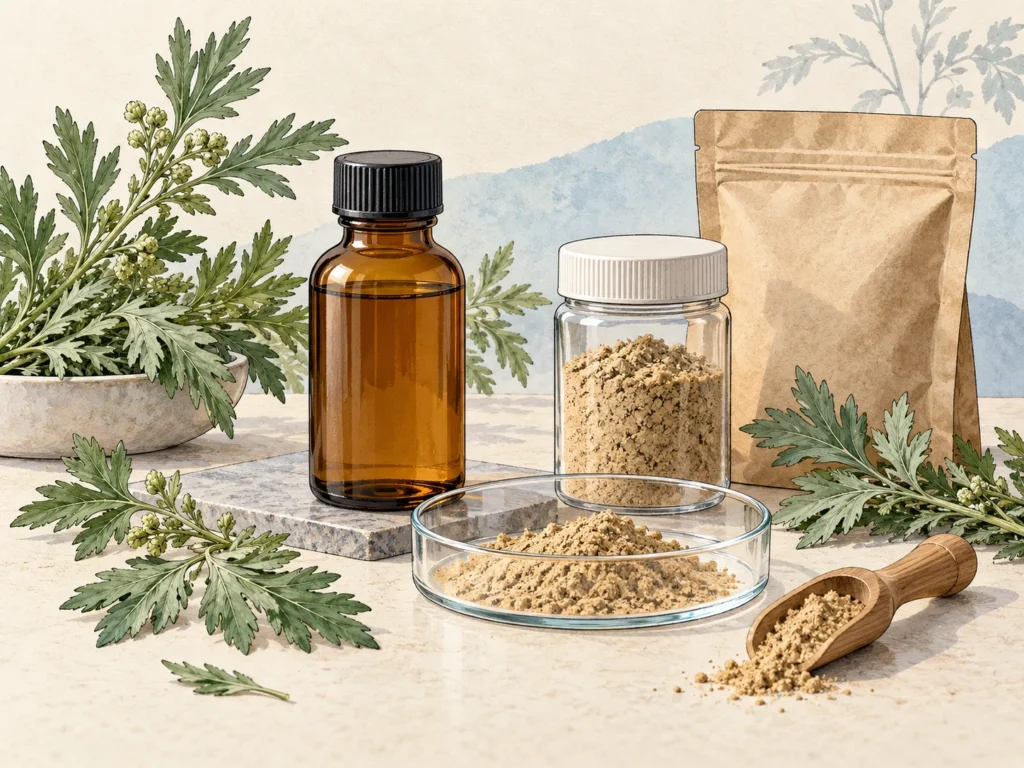
Mugwort extract is a botanical preparation whose specification depends on its source, process and composition. Before buying, confirm the plant identity, plant part, extraction information, supplied form, solvents or carriers, concentration description and intended application. A liquid extract, an extract powder and ground mugwort leaves are different materials.
A supplier may offer a water-based liquid, a glycerin-containing ingredient or a powder with a stated extraction ratio. None of those short descriptions provides all the information needed to compare quotations or select an ingredient for a formulation.
This guide focuses on the extract specification. For mechanically milled plant material, see our separate mugwort powder buying checklist.
What is mugwort extract?
It is a preparation obtained by processing botanical material to extract selected constituents, then supplying the resulting ingredient in an agreed form. The starting plant, process and final preparation determine what the buyer receives.
Ask the supplier to identify the botanical name and plant part. Mugwort is a common name used for different Artemisia plants, so a name on the sales page should not silently replace the specified botanical identity.
The finished ingredient may include a solvent, carrier, preservative or other components. A liquid that looks like a single ingredient can still be a prepared mixture. Request the complete supplied composition.
Liquid extract, powder or leaf powder?
| Form | What to establish | Buying implication |
|---|---|---|
| Liquid mugwort extract | Extract preparation, supplied medium, other ingredients and physical specification | Compare the complete ingredient, including its compatibility with the intended formulation |
| Mugwort extract powder | Extraction and drying information, composition, carrier and concentration description | Do not assume the powder is carrier-free or fully soluble |
| Milled mugwort leaf powder | Ground botanical material, plant part and particle specification | It is not simply another name for an extract powder |
| Mugwort essential oil | Concentrated aromatic ingredient and its specific production information | It is not a direct replacement for a general cosmetic extract |
Choose the material for the intended process. A formulator asking for a particular liquid extract may not be able to substitute a powder without changing the formulation and assessment.
Why do solvents and carriers matter?
The extraction medium and the final supplied medium are related questions, but they are not always the same. Ask how the ingredient is made and what is present in the container you will receive.
For example, a supplier can offer an extract prepared in water and supplied with glycerin and a preservative. That describes a formulated ingredient, not a bottle of pure dry plant constituents. Other products can use different arrangements.
For a powder, ask about added carriers and their purpose. A carrier is not automatically a quality defect, but it needs to be disclosed so the buyer can assess the actual material and compare price on the right basis.
How should you interpret ratios and percentages?
Ask what the number refers to. An extraction ratio, a proportion of prepared extract in a liquid and a measured constituent level describe different things.
A larger ratio or percentage should not automatically become a ranking of quality or suitability. Obtain the supplier's definition, calculation basis and relevant supporting information. Keep that explanation with the specification.
If a constituent is specifically controlled, identify it, its acceptance range and the method used. If no such standardization is offered, do not describe the material as standardized simply because a ratio appears on a label.
What does “water-soluble” need to mean for your project?
Ask for the supplier's conditions and formulation information. A statement about a particular ingredient does not establish that all mugwort extracts behave the same way in every formula.
Have the responsible formulator evaluate the sample in the intended process. Record appearance, dispersion or dissolution, sediment if present and compatibility observations. Do not assume that stirring a small sample into water demonstrates suitability for the final product.
Keep use-level and process questions with the actual ingredient supplier and qualified formulator. This article does not provide a universal percentage, temperature or recipe for cosmetic manufacturing.
What should a purchasing specification include?
Explain whether you need a cosmetic formulation ingredient, a development sample or another defined product. Provide the destination, intended application and approximate quantity before comparing suppliers.
| Area | What to confirm |
|---|---|
| Botanical identity | Species, plant part, source information and product code |
| Process and composition | Relevant extraction information, solvents, carriers, preservatives and other components |
| Concentration description | Meaning of ratios, extract percentages and any standardized constituent claim |
| Physical and quality criteria | Agreed appearance, form-specific characteristics and relevant quality assessment information |
| Batch documentation | Lot identity, applicable analysis records, dates and traceability |
| Packing and handling | Container, closure, storage instructions, supported shelf-life information and shipment requirements |
Do not copy numerical limits from an unrelated extract and assume they fit your project. Set the criteria for the actual ingredient, application and destination with the relevant reviewer.
Which documents should match the delivered material?
The product specification describes what has been agreed. A batch analysis record or certificate of analysis should identify the relevant product and lot and show what was assessed.
Check dates, sample identity, methods and acceptance criteria. Ask whether additional reports apply to the offered preparation or to a different ingredient. A general factory document cannot answer every question about a specific batch.
Factory verification and ingredient assessment serve different purposes. A visit can help clarify production, storage and traceability, while composition and other quality characteristics need the appropriate evidence.
How should samples and repeat orders be handled?
Request a representative sample with its product code, batch and relevant records. Ask whether it comes from available stock or a development preparation.
Keep the sample identification and the formulator's evaluation together. Record the approved version and which changes need approval, including plant source, solvent, carrier, preservation or concentration description.
For a repeat order, refer to the specification version and batch arrangement rather than only the name “mugwort extract.” This makes differences easier to investigate before the material enters production.
How do you compare supplier quotations?
Send the same brief to each candidate and ask for exceptions. A lower price may cover a different preparation, carrier content, pack size or quality scope.
Compare the actual supplied material and how it can be used in the intended project. Check minimum quantities, samples, packing, delivery terms and the point from which lead time is counted.
GCB can help identify suppliers, clarify documents and quotations, and coordinate samples. If the goal is a finished private label product, our mugwort sourcing and OEM guide explains the broader manufacturing and packaging discussion.
Frequently asked questions
Is mugwort extract powder the same as ground leaves?
No. Ground leaves are milled botanical material. An extract powder is a different preparation and may contain additional components such as a carrier.
Is liquid mugwort extract always just extract and water?
No. Ask for the complete supplied composition. It may include glycerin, another medium, a preservative or other ingredients.
Does a larger extraction ratio mean a better ingredient?
Not automatically. Establish the meaning and calculation basis, then compare the specification and suitability for the intended application.
Are all mugwort extracts water-soluble?
Do not assume so. Confirm the exact supplier specification and have the responsible formulator evaluate the ingredient in the proposed process.
Can an extract be sold directly as a facial essence?
A raw formulation ingredient is not automatically a finished skincare product. The final composition, product assessment, packaging and directions need to be defined.
What should I send GCB for an ingredient search?
Send the intended application, destination, required form, known botanical or composition requirements, approximate quantity and any existing specification.
Related guidance: OEM & Private Label · Samples & MOQ · Pricing & Payment
Updated October 18, 2026.
About Global China Bridge
Global China Bridge is a China-based sourcing and product-development service company helping overseas entrepreneurs, small brands, retailers and other small businesses work with Chinese manufacturers. We support supplier searches, factory verification, samples, OEM and private label packaging, production follow-up, quality checks and shipping coordination.
Planning a mugwort extract project? Tell us your target country, product requirements, approximate quantity and packaging idea. Small orders are welcome to discuss. We start with a free conversation, then agree a clear scope and fee for any work.