
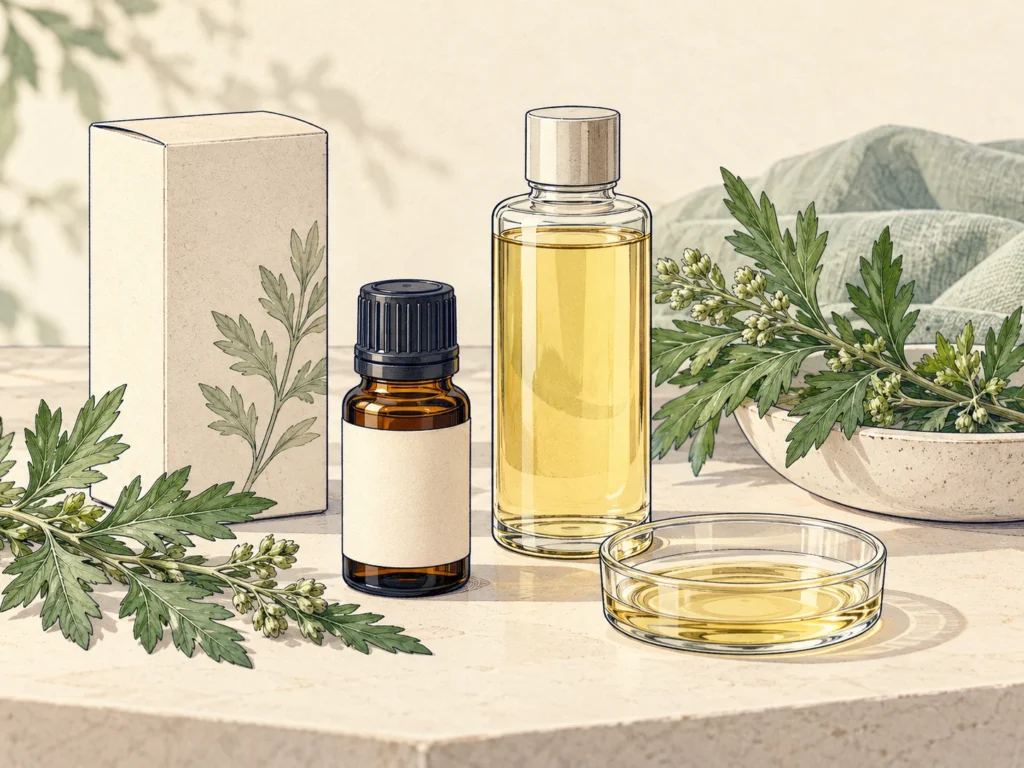
Before buying mugwort essential oil, establish exactly what the bottle contains. A concentrated aromatic plant oil, a mugwort-infused carrier oil and a finished skincare blend are different products. Compare botanical identity, production method, composition, intended use, batch information and packaging before comparing prices.
The word “mugwort” can appear on a small essential-oil bottle, a larger massage-oil blend or a cosmetic ingredient listing. Similar names do not mean the products can be substituted for one another.
This guide explains the main distinctions and the information an overseas retailer, small brand or ingredient buyer should request from a supplier.
What is mugwort essential oil?
The name commonly describes a concentrated aromatic ingredient obtained from a mugwort plant. Suppliers may identify a distillation process, but you should confirm the actual process for the offered material rather than relying on the sales name.
Ask for the botanical name and plant part. Mugwort is a common name used for different Artemisia plants. A product specified by species should not be replaced with another Artemisia oil without approval.
Also establish whether the bottle contains only the identified oil or a mixture. “Natural,” “pure” and “premium” need a clear explanation of composition and supporting information. None of those words provides a complete purchasing specification.
Essential oil, infused oil or extract: what is the difference?
| Product description | What to establish | Main buying question |
|---|---|---|
| Mugwort essential oil | Concentrated aromatic plant ingredient and its production process | Exact identity, composition and suitable intended application |
| Mugwort-infused oil | Botanical material prepared in a carrier oil | Carrier identity, botanical preparation and complete composition |
| Finished oil blend | A formulated product containing several ingredients | Full ingredient list, directions and finished-product information |
| Mugwort extract | A separate botanical preparation, potentially in water, glycerin or another medium | Extract specification and compatibility with the intended formulation |
A carrier oil is not a defect when the product is correctly described as a blend or infusion. The problem is an unclear quotation that makes unlike products look equivalent. Ask the supplier to state the full product identity in writing.
How should you read the label?
Look for the actual product name, botanical ingredient, other ingredients, net contents, batch identification and directions. Check the current pack rather than an old review or a short online description.
For a raw material, ask for the technical specification and relevant safety information. For a retail product, ask what the finished product is intended for and whether the instructions fit that purpose. A cosmetic oil blend and a raw ingredient need different buyer decisions.
Do not assume a plant-derived ingredient is suitable for every application. This is not a guide to ingesting essential oils or using concentrated oil directly on skin. Follow the supplied product instructions; commercial formulation needs an appropriately qualified formulator.
What can aroma, color and appearance tell you?
They can help you compare samples, but they cannot establish complete identity or purity. A stronger smell does not automatically mean a better product, and color alone is not a reliable ranking system.
Use labeled samples and consistent evaluation conditions. Record noticeable differences, separation, sediment if present, damaged closures or packaging leaks. Ask the supplier whether each observation is expected for the exact product.
For an aromatic formulation, have the responsible formulator evaluate the ingredient in the proposed finished product. A sample that smells appealing on its own may behave differently alongside the other ingredients.
What information should a bulk buyer request?
Explain whether you need an ingredient for professional formulation, a finished blend for resale or a product-development project. Give the supplier your destination, quantity, pack size and intended application.
| Area | Information to request |
|---|---|
| Identity | Botanical name, plant part, product code and relevant source information |
| Composition and process | Production method, any carrier, blend components or other added ingredients |
| Technical information | Agreed specification, relevant safety data and batch-specific quality records |
| Application | Intended use and information needed by the formulator or qualified reviewer |
| Packing | Container, closure, fill quantity, leakage protection and storage instructions |
| Commercial scope | MOQ, sample arrangements, inspection scope, delivery term and lead-time basis |
If the supplier provides an analytical profile, check the product, batch, date and method. Ask what the results establish and what they do not. A generic brochure should not silently become evidence for every shipment.
How do you compare samples and repeat orders?
Label the sample with its supplier, product code, lot and receipt date. Ask whether it represents available production stock or a separately prepared sample. Retain its documents and an appropriate reference sample.
Record the approved specification, packing and acceptance points before ordering. Agree how later batches will be identified and which changes require approval. Include changes to botanical source, processing, carrier ingredients or the supplied container.
A factory visit can help clarify who produces the oil, how stock is handled and which operations are subcontracted. It does not prove complete chemical identity by looking at the production line. Define the product assessment and supplier checks separately.
What packaging should you discuss?
A bottle and dropper that look attractive may still be unsuitable for the actual product. Confirm compatibility of the container, cap, liner and dispensing components. Ask for the basis of the supplier's packing recommendation and evaluate the proposed assembled pack.
Compare closures, seals, label durability and transport protection. For larger containers, discuss how they are sealed, identified and handled. Storage and shelf-life information should relate to the material and packaging actually supplied.
For private label products, separate the ingredient quantity from printed-packaging minimums. Confirm artwork approval, batch coding, net contents and the wording for the intended market before printing. A packing change should not be treated as a purely decorative choice.
What claims should a brand build around the product?
Start with the actual product and supported intended purpose. Avoid taking a supplier's traditional-use story and turning it into a promise to treat disease or produce a medical result.
Agree the product brief and label approach before samples become a large order. A good sourcing discussion asks what the material is, who will make the finished product and what information the buyer needs to assess it.
GCB can coordinate supplier searches, samples and private label packaging discussions. Our mugwort ingredient sourcing guide explains the wider China-side process.
Frequently asked questions
Is mugwort essential oil the same as mugwort-infused oil?
No. An infused oil includes a carrier and a botanical preparation. An essential oil is a different ingredient type. Confirm composition and intended use before comparing them.
Does “pure mugwort oil” provide enough information?
No. Ask for botanical identity, process, composition, specification and batch information. “Pure” on the front label does not answer those questions.
Can mugwort essential oil replace mugwort extract in skincare?
Do not substitute them directly. They are different preparations, and the formulation needs to be assessed for the exact ingredient by a qualified formulator.
Can smell prove that an oil is genuine?
No. Aroma is one sample observation. It does not establish complete composition, identity or suitability for the intended use.
Can a small brand request custom bottles and labels?
Yes, subject to supplier capability and packaging minimums. Discuss compatible bottles, closures, printing, product requirements and approval samples together.
What should I send GCB for a first discussion?
Send your intended application, destination, approximate quantity, preferred pack size and whether you need a raw ingredient or a finished product. Include any existing specification or reference.
Related guidance: OEM & Private Label · Samples & MOQ · Pricing & Payment
Updated October 18, 2026.
About Global China Bridge
Global China Bridge is a China-based sourcing and product-development service company helping overseas entrepreneurs, small brands, retailers and other small businesses work with Chinese manufacturers. We support supplier searches, factory verification, samples, OEM and private label packaging, production follow-up, quality checks and shipping coordination.
Planning a mugwort oil project? Tell us your target country, product requirements, approximate quantity and packaging idea. Small orders are welcome to discuss. We start with a free conversation, then agree a clear scope and fee for any work.