
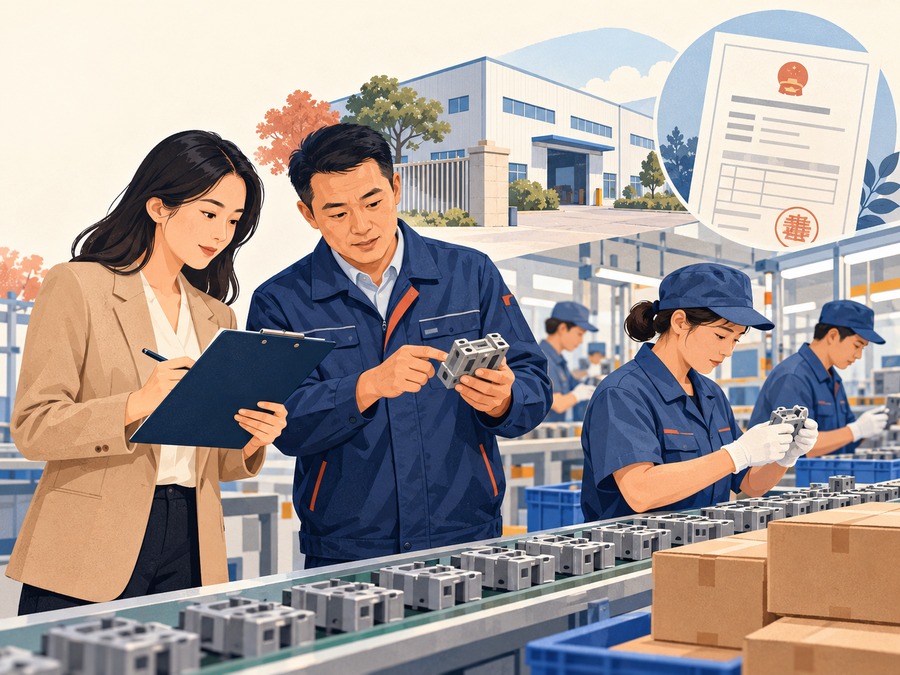
To check if a Chinese company is legitimate, start by independently verifying its legal identity and operating history. Before trusting it with production, also check the actual factory, the work it performs, and the people responsible for your order. A registered company can still be the wrong supplier for your product.
You have found a supplier in China. The price looks workable, the salesperson replies quickly, and the factory videos look convincing. Now they are asking you to approve the sample or pay a deposit.
But you are still wondering: is this really their factory? Have they been making this kind of product for as long as they say? If something goes wrong, will anyone take responsibility and help put it right?
Those questions deserve more than another brochure. You are putting your money, launch schedule, and reputation with your own customers into someone else's hands. The checks should help you understand what happens after you place the order.
Start by identifying the business behind the conversation
Ask for the company's full registered Chinese name, its Unified Social Credit Code, and a clear copy of its business licence. An English trading name alone may not be enough to identify the legal business accurately.
For a mainland Chinese company, independently check the details against the National Enterprise Credit Information Publicity System or arrange for someone capable of reading the Chinese records to do so. Use the Chinese name and code to identify the right entity rather than relying on a screenshot supplied by the salesperson. A Hong Kong or other overseas entity needs checking through the registry for its own jurisdiction.
Review the registration status, establishment date, registered address, business scope, and relevant public records. Where penalties or abnormal-operation entries appear, understand the details and dates before drawing conclusions. An empty search result is a reason to investigate the name and access limitations, rather than immediate proof of fraud.
Next, connect that identity to your transaction. Which business issues the quotation? Which one will sign the order, receive payment, and operate the production site? If different companies are involved, ask for an explanation supported by appropriate documents.
A manufacturer may use a related sales company or an export agent. That arrangement needs to be understood. Do not send money while you are still unsure who you are buying from or why the beneficiary is different. Independently confirm any later change in payment instructions through a contact method you have already verified.
Verify how long the company and the factory have actually operated
“Twenty years of manufacturing experience” can mean several things. The legal company might be twenty years old. The founder might have worked in the industry for twenty years. Or a recently registered sales company might represent an older factory.
Check the establishment date yourself, then ask when the current production site began operating and how long it has made products similar to yours. Where an earlier business or related factory is part of the story, ask how the entities connect and what evidence supports that history.
Past production records, dated quality documents, and customer references that can be checked with permission may help. Look for a consistent account across the records and what you see at the factory.
Age provides context. It does not tell you whether today's team can handle your materials, customization, quantities, and delivery requirements. A newer factory may be competent; an older business may have changed its staff, equipment, or product focus.
Confirm there is a real operating factory behind the pictures
A real address matters, but you need to know what happens there. A registered office, showroom, warehouse, and production workshop serve different purposes.
If the supplier claims to manufacture your product, establish the actual production address and the business operating that site. Check whether it owns or leases the premises, or is showing you a separate manufacturer's facility. A leased workshop can be entirely legitimate; the question is who operates it and how it relates to your order.
Photographs and a live video call can support preliminary checking. Ask to see a connected view of the entrance, workshop, relevant equipment, and current work rather than isolated clips. Even then, remote viewing leaves gaps: you may not see the full workflow, confirm the relationship between businesses, or examine workmanship closely.
Before a meaningful production commitment, independently verify the factory's existence, operating history, and scale. Where the remaining questions concern what is actually happening on the production floor, arrange an on-site check by yourself or a suitable person acting for you.
At the factory, follow the work your product will require
A useful visit starts with your product specifications. Otherwise, you may spend an hour looking at impressive machinery that has little to do with your order.
Ask to follow the relevant process from incoming materials through production, finishing, inspection, and packing. Establish which steps happen at that site and which are outsourced. If a critical process takes place elsewhere, include that arrangement in the checking plan.
Does the scale fit your order?
Verify the claimed workshop area, relevant workforce, equipment, and operating lines as far as the agreed access allows. Separate equipment installed from equipment currently available for your work. Ask about normal output, shift arrangements, current commitments, and the stage most likely to limit production.
A large building does not automatically mean your small order will receive attention. A smaller specialist workshop may be a better fit, provided its capability, workload, and controls support your requirements.
How carefully is the work being done?
Watch how operators handle materials, follow instructions, check their own work, and respond when something looks wrong. Are reference samples available? Are parts protected from damage? Are rejected pieces identified and separated? Do supervisors investigate defects or simply move them along?
The seriousness of the work becomes more visible through these actions than through a promise that “our workers are very experienced.” Avoid judging people from a brief impression alone. Observe several relevant operations and compare what you see with the factory's procedures and records.
Can the workmanship meet your requirements consistently?
Look at ordinary production pieces as well as selected display samples. Depending on the product, examine assembly, dimensions, surface finish, stitching, printing, fit, or other important details. Ask how the factory measures those features and what happens when results fall outside the agreed requirements.
For a technically demanding product, use an inspector or specialist who understands the process. A general visit cannot replace material testing, product safety assessment, or a technical audit.
Ask how the promised delivery date will be achieved
“No problem, we can deliver next month” sounds helpful. Before building your launch around it, ask what must happen between now and shipment.
Check the material lead time, sample approval deadline, production slot, outsourced operations, inspection time, and packing arrangements. Ask which of these are confirmed and which are still assumptions. Current workload matters as much as a factory's theoretical capacity.
Clarify what starts the lead-time clock. Is it receipt of the deposit, final artwork approval, arrival of materials, or approval of the pre-production sample? Also distinguish goods ready at the factory from dispatch and arrival in your country.
Agree on milestones, who will report progress, and what evidence will accompany updates. Discuss how delays will be raised and what options are available if a milestone slips. Put delivery obligations and any agreed remedies in writing; a verbal guarantee does not establish that the schedule is achievable.
A site visit can help assess the starting position. Once your order is underway, production follow-up checks whether that plan is actually being followed.
Notice how the supplier handles the questions that take effort
A supplier can be quick to quote and slow to solve a difficult issue. Before you commit, ask about something that genuinely matters to your project: a sample defect, a packaging constraint, a material substitution, or a delivery risk.
Does the salesperson bring the right production person into the conversation? Do they investigate, explain the cause, and propose a workable action? Is there a named person responsible and a date for the next answer?
Careful suppliers will sometimes tell you a request is impractical or costs more than expected. A clear explanation gives you something to decide. Repeated reassurance without technical answers leaves the problem unresolved.
Check this behaviour during sampling, too. If a sample needs correction, record what was changed and whether the next version addresses it. How a business handles a small, real problem offers useful evidence about the working relationship, although it cannot guarantee future behaviour.
Some questions need someone on the ground in China
You can check documents, discuss specifications, and review updates from thousands of miles away. Those are necessary parts of the work. But they do not let you walk the production line, examine a finish in your hands, or follow an unresolved issue from the salesperson to the workshop supervisor.
When your uncertainty concerns actual production conditions, another message may not settle it. Someone needs to be there, ask the relevant questions, look at the work, and record what was found.
You do not necessarily have to make the trip yourself. A suitable local representative or independent inspector can carry out an agreed check. What matters is their competence, access, independence, and reporting—not simply their location in China.
The report should distinguish documents reviewed, conditions observed, supplier statements, and questions that remain unanswered. A visit with dated observations and clear limitations is more useful than “the factory looks good.” One visit also cannot promise the quality of every future batch.
Use each check to answer a specific purchasing question
| Your question | Useful evidence | What still needs checking |
|---|---|---|
| Does this legal business exist? | Independently checked registration records and identity documents. | Who you are communicating with and how the entity connects to the transaction. |
| Is the factory history and scale credible? | Establishment records, operating history, site evidence, and relevant on-site observations. | Changes in the business and capacity available for your particular order. |
| Can it make my product properly? | Relevant production processes, workmanship checks, sample results, and quality records. | Technical requirements, necessary testing, and consistency during bulk production. |
| Can it meet my schedule? | Material status, workload, an agreed production plan, and progress evidence. | Whether milestones are met as the order proceeds. |
| Will problems receive attention? | Observed handling of questions and sample corrections, named owners, and follow-through. | Performance over time and clear responsibilities if a dispute arises. |
For example, a real company may still need further checking
Imagine you are preparing a first order of 300 branded products. The supplier's registration checks out, and its website describes years of manufacturing experience. You receive a good sample and a short delivery promise.
During a visit, you discover that the main item is assembled at the factory, but a finish important to your design is handled elsewhere. The sample was prepared individually, and the packaging has not yet been booked. The production manager also says the proposed slot depends on another order finishing first.
This is an illustrative situation, not a reported Global China Bridge case. Nothing in it automatically makes the company fraudulent. It shows why confirming registration alone would leave important commercial questions unanswered.
You could now check the finishing arrangement, approve an appropriate production sample, and agree on a schedule that includes packaging. If those issues remain unresolved, you can delay the commitment or consider another supplier before spending more.
Begin with the uncertainty affecting your decision
You may already have a supplier you want to work with. The next step does not have to be another factory search. It may be a focused check of that company's identity, the proposed production site, or one unanswered question about the order.
At Global China Bridge, we can discuss what useful work is possible for your supplier and product. Depending on the project, information access, and supplier cooperation, that may involve clarifying the parties, following up on production questions, or arranging appropriate on-site checking and specialist support.
Before paid work begins, we agree on the scope, fees, and what you should receive. Travel, independent inspection, testing, or other third-party charges need to be discussed separately. The findings should help you decide what to do next, with remaining uncertainties stated clearly.
Know who you are asking to help, too
I'm Bryan, the founder of Global China Bridge, based in Beijing. I help overseas entrepreneurs and small businesses explore and coordinate product and manufacturing work in China.
Helping your business move forward gives ours a foundation to grow. Work you entrust to us deserves careful attention. That means asking the questions that matter, communicating honestly about what has been checked, and following up on the work we agree to undertake.
Meet Bryan
Read why I started Global China Bridge and how I approach a client's plans.
Meet Bryan and read our story →Explore Sourcing Stories
Read about the questions and practical decisions involved in our sourcing work.
Read our sourcing stories →Tell me what you still need to know before ordering
You might be unsure whether a supplier owns the factory it shows, whether its production capacity fits your quantity, or whether a promised deadline is realistic. Start with that question.
Share a brief outline of the product, expected quantity, destination market, and the decision you are facing. Keep confidential designs and bank details out of the first message.
The introductory conversation is free, with no obligation to proceed. If there is a useful way to help, we can start with a small, clearly defined task rather than asking you to commit to a whole sourcing project.
Discuss your supplier with Bryan
Prefer email? Write to service@globalchinabridge.com.
Questions buyers often ask
Does a business licence prove a Chinese supplier is reliable?
It helps identify the legal business when independently checked. It does not establish the authenticity of the person contacting you, production capability, workmanship, or future order performance.
How can I verify a factory's claimed years of experience?
Check the legal establishment date, then separately examine the current site's operating history and relevant product experience. Ask for evidence when the claim includes a founder's earlier work or a related company.
Is a small factory less trustworthy than a large one?
Size alone does not establish trustworthiness. Assess the relevant equipment, skills, capacity, workload, and attention your order would receive. The factory needs to fit your requirements.
Can a video call replace a factory visit?
It can help with preliminary checking. It has limits when you need to examine workmanship, trace production processes, review records on site, or understand how an issue is being handled.
Do I need to travel to China personally?
Not always. A suitable local representative or independent inspector may check the site for you. Agree on the questions, competence required, access, evidence, and reporting before the visit.
What if the supplier refuses access to its factory?
Ask why and whether an appropriate alternative is possible. Confidentiality or production restrictions may be relevant. If the necessary evidence remains unavailable, treat the capability as unverified and reconsider the commitment.
Does an on-site check guarantee quality or delivery?
No. It provides evidence about the conditions and records checked at that time. Approved specifications, suitable testing, production follow-up, and shipment inspection may still be needed.
Can you help check a supplier I found myself?
We can discuss your supplier, product, and questions first. The appropriate task depends on access, cooperation, location, and any specialist expertise required.
Continue planning your purchase
Updated: October 5, 2026