
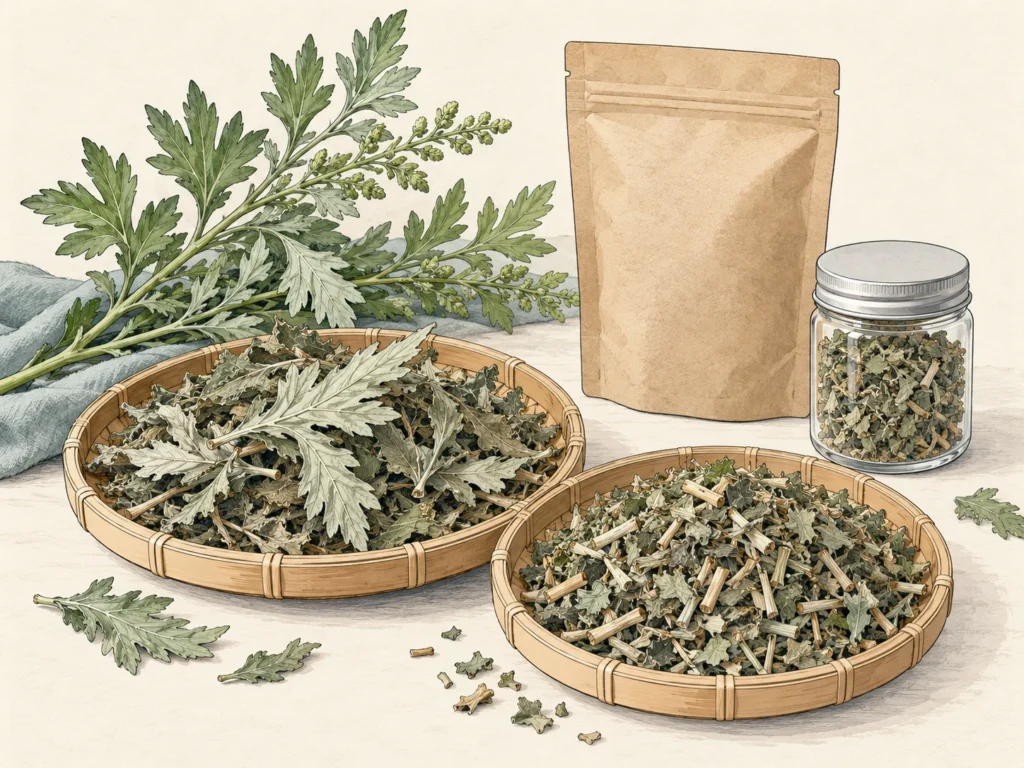
Dried mugwort is dried plant material sold in forms such as whole leaves, cut herb or other processed grades. Before buying, identify the botanical source, plant parts, cut size, condition, intended use and batch records. Compare suppliers against the same specification rather than choosing by a photograph or price alone.
A bag of intact leaves and a bag of finely cut herb can both be sold as dried mugwort. Their appearance, handling and suitability for a buyer's process can be quite different. Even two cut-herb products may include different proportions of leaves, stems and fine material.
This guide explains how to compare the forms, inspect samples and plan consistent purchasing for an overseas small business.
What forms of dried mugwort are available?
Ask for photographs of the actual material and an exact description. Product names such as “whole,” “cut,” “fine cut” or “premium” are starting points, not complete specifications.
| Form | What to expect | Check before ordering |
|---|---|---|
| Whole dried leaves | Leaves with more of their original shape visible; some breakage may occur | Leaf condition, stem content, breakage, packing and agreed appearance |
| Cut or cut-and-sifted herb | Plant material reduced to a smaller cut size | Included plant parts, cut range, fine material and consistency |
| Mugwort powder | Milled material with a much smaller particle form | Separate powder identity, particle and composition specifications |
| Moxa wool or floss | A fibrous processed material associated with moxa products | Processing and intended use; do not treat it as equivalent to ordinary dried leaves |
The right form starts with the intended product. Send the supplier a clear application and material description. A product sold for one use should not automatically be assumed suitable for another.
Confirm the botanical source and plant parts
Mugwort is a common name used for more than one Artemisia plant. Ask for the botanical name on the specification and the supplier's identity information. Artemisia vulgaris and Artemisia argyi, for example, should not be silently substituted when a buyer has specified one.
Clarify whether the order is for leaves, aerial parts or a defined mixture. If the proportion of stems matters, make it an acceptance point. A photograph of a few attractive leaves does not establish what is packed in every bulk sack.
For an origin claim, distinguish the growing area, processing location and seller's address. Ask how harvest or processing information is recorded when that information forms part of your product requirements.
Whole leaves or cut herb: which should you choose?
Whole leaves can make some visible characteristics easier to review, but the product still needs identity and quality information. They can also break during handling, so agree what amount of breakage is acceptable and how the material will be packed.
Cut herb may suit a process that needs a more defined size, but “cut” alone is vague. Ask for the cut range and how the supplier handles fines, larger pieces and stem material. Compare the sample with your filling, processing or packing requirements.
For a bath-bag project, for example, the bag material, seal, fill weight and herb cut should be considered together. A fill that looks suitable loose in a dish may behave differently inside the proposed inner bag. Obtain a complete sample before approving the retail pack.
What can you check by looking at a sample?
Examine a representative quantity, not only a few pieces on top. Record the distribution of leaf, stem and fine material. Look for unexpected foreign material, insects, damp patches, unusual clumping or visible deterioration.
Compare color and odor under consistent conditions. Natural differences can occur between lots, but a noticeable change should have an explanation and be assessed against agreed limits. Color alone cannot establish botanical identity, age or overall quality.
If you suspect mold or other deterioration, separate the material and raise the issue with the supplier. Do not assume brushing, airing or repacking restores suitability. Visual review is a useful screening step, not a substitute for every required quality check.
Why drying, storage and packaging matter
Ask how the supplier controls drying, stores finished material and protects each lot. Moisture information needs an agreed criterion and method. A claim that the leaves “feel dry” is not a complete purchasing standard.
Discuss clean inner packing, closures, transport protection and storage instructions. The appropriate arrangement depends on the material, shipment and intended use. A decorative outer pouch is not enough if the inner packing is unsuitable.
For overseas orders, agree how long the goods may remain in storage before dispatch and what batch and date information accompanies them. Ask how shelf-life statements are supported and what storage conditions they assume. There is no universal shelf life to apply to every bag of dried mugwort.
How do you compare batches rather than single samples?
A good-looking sample is useful only when it can be connected to a proposed specification and supply arrangement. Ask which lot it came from, whether it represents available stock and how later lots will be selected.
Keep a labeled reference sample and record the acceptance points: identity, plant parts, cut size, appearance, fine material, packing and the agreed quality criteria. Identify what variation can be accepted and what requires your approval.
If an order combines several lots, ask for the lot breakdown and identification on the packs. This makes it easier to compare deliveries, investigate a problem and discuss a repeat order without relying on memory.
What belongs in a dried mugwort purchase specification?
| Specification area | What to record |
|---|---|
| Material identity | Botanical name, plant part, product code and relevant origin information |
| Physical form | Whole or cut, size requirements, stem content, fines and acceptable breakage |
| Condition and quality | Appearance, odor, moisture and relevant identity, microbial or contaminant requirements |
| Batch documentation | Lot references, applicable analysis records, dates and traceability information |
| Packing | Inner protection, net weight, closures, labels and outer shipping pack |
| Order terms | Quantity, sample approval, inspection scope, delivery term and issue-handling arrangements |
Choose the criteria for the application and destination. Do not assume a broad description such as “herbal grade” settles every question. Ask the supplier to identify any requirement it cannot meet before you compare the final quotations.
What changes when you want a private label product?
Buying dried mugwort in bulk and launching a finished retail product are different tasks. Define whether you need loose material, prefilled bath bags, retail pouches or another format. Set the net contents, inner packing, instructions and intended claims before arranging printing.
Ask for product and packaging minimums separately. Approve the material and a complete packed sample, including seals, labels and outer presentation. Agree who handles the different processing and packing steps.
For a first order, an achievable standard pack may be easier to compare with a fully customized option than a vague request for the lowest MOQ. GCB can help work through sample and MOQ choices and supplier discussions.
Receiving an overseas shipment
Check outer-pack condition, lot labels, net contents and the supplied records on arrival. Compare representative material with the approved specification. Record discrepancies before mixing the new stock with existing inventory.
Store the goods according to the agreed instructions and keep lot identification through repacking or further processing. For a quality issue, provide the supplier with the lot number, photographs, observations and relevant records. Clear traceability makes the discussion more useful than a general complaint that the latest shipment looks different.
Our mugwort ingredient sourcing guide explains how we can coordinate the China-side supplier, sample, packaging and production work.
Frequently asked questions
Are whole leaves better than cut dried mugwort?
Neither is automatically better. Choose the form for the application, then compare identity, condition, included plant parts, size and packing against an agreed specification.
Is dried mugwort the same as moxa wool?
No. Moxa wool is a processed fibrous material. It should not be treated as interchangeable with ordinary whole leaves or cut herb without confirming the intended product requirements.
Can dried mugwort be selected by color alone?
No. Color is one observation. It does not establish species, age, composition or overall quality. Review identity, traceability, condition and the relevant quality information too.
How long can dried mugwort be stored?
Use the supplier's supported shelf-life and storage information for the actual material and packing. Do not apply one storage period to every product sold as dried mugwort.
What should I request with a sample?
Ask for botanical identity, plant parts, form or cut size, sample lot, packing details and the relevant specification and quality records. Explain your destination and intended application.
Can GCB coordinate private label bath bags or retail pouches?
We can discuss material sourcing, packing suppliers, samples and private label packaging. The workable quantity, product requirements and fees are confirmed for the project.
Related guidance: OEM & Private Label · Samples & MOQ · Pricing & Payment
Updated October 18, 2026.
About Global China Bridge
Global China Bridge is a China-based sourcing and product-development service company helping overseas entrepreneurs, small brands, retailers and other small businesses work with Chinese manufacturers. We support supplier searches, factory verification, samples, OEM and private label packaging, production follow-up, quality checks and shipping coordination.
Planning a dried mugwort project? Tell us your target country, product requirements, approximate quantity and packaging idea. Small orders are welcome to discuss. We start with a free conversation, then agree a clear scope and fee for any work.