
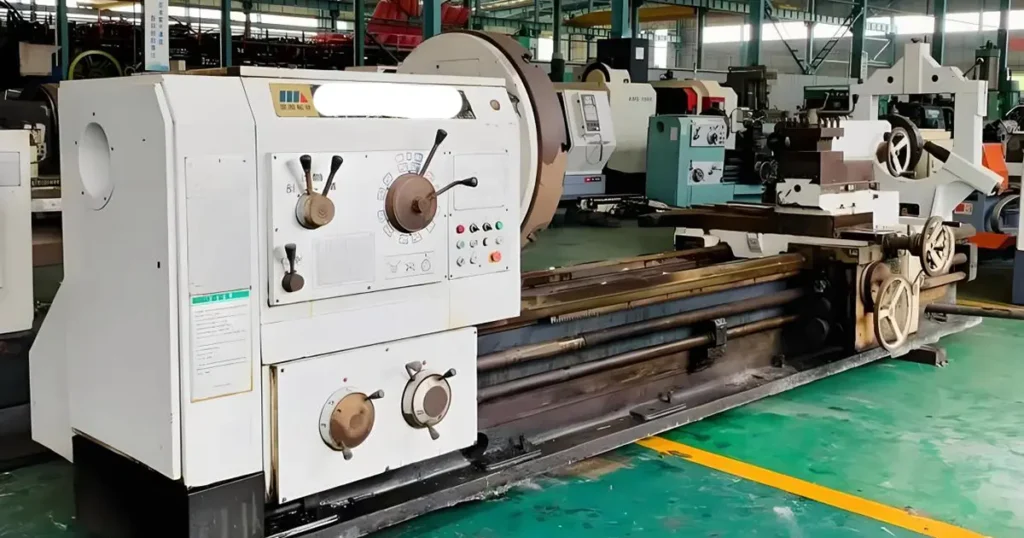
Buying a used CNC machine from China can save time or capital, but a low price is not evidence of a sound machine. Before paying a substantial balance, verify the exact serial-numbered asset, its condition and controller functions, the seller’s right to sell it, export feasibility, and how it will be disconnected and packed. Agree which checks require a qualified machine-tool engineer.
A used machining center, CNC lathe or five-axis machine can be attractive when a new unit is outside the budget or lead time. Yet the true cost includes repair, tooling, rigging, shipping, installation and possible downtime. The advertised saving of 40–60% sometimes quoted in sales pitches is not a reliable general benchmark. Compare the landed, commissioned cost of the particular machine with realistic alternatives.
Seven risks to investigate before buying
1. Geometric wear, spindle condition and axis performance
Photographs seldom reveal backlash, spindle taper damage, bearing problems, guideway wear or inaccuracies that emerge after warm-up. Request the model, serial number, hours where available, maintenance history and the manufacturer’s performance specifications. A qualified technician can agree appropriate runout, backlash, geometry and test-cut measurements for that machine. A single universal runout figure is not a defensible pass/fail limit across all models and test setups.
2. Cosmetic refurbishment presented as a full rebuild
Fresh paint, cleaned covers and a tidy workshop can improve presentation without restoring mechanical accuracy. Ask precisely what “refurbished” means: which parts were replaced, by whom, with what records and warranty? Compare the serial plate, controller information and relevant service documentation. Treat hours displayed by a controller as one clue, not conclusive proof of usage.
3. Controller options, backups and software support
Identify the CNC control, installed options, parameters, backup media, alarms and service access. Ask whether the functions needed for your application can be demonstrated under the current configuration and whether support, license or transfer restrictions apply. Do not assume a used machine will remotely lock itself merely because it is connected to a network; the practical issue is to verify the specific control and legitimate functionality before purchase.
4. Export control and shipment eligibility
Some high-performance machine tools can fall within China’s dual-use export controls, depending on technical characteristics and current rules. Five axes alone do not prove that a particular machine needs a license. Obtain the manufacturer’s specifications and ask the exporter or a qualified compliance adviser to classify the exact machine before committing to shipment. China’s current dual-use control resources and the 2026 export declaration requirements for relevant machine tools are starting points; destination-country import and any applicable third-country re-export rules need separate review.
5. Seller authority and possible third-party claims
Confirm who owns and physically holds the machine, whether a broker has authority to sell it, and which legal entity will issue the invoice and receive payment. Ask for the acquisition and transfer records that exist, plus written confirmation regarding any lease, security interest or dispute. One VAT invoice or an informal “title search” cannot by itself prove that no third party has a claim. Where the stakes warrant it, obtain legal advice on the particular transaction.
6. Disconnection, rigging and seaworthy packing
A machine that runs correctly before sale can be damaged during disconnection or transport. Agree who records the pre-disconnection condition; handles manufacturer-recommended axis, spindle and counterweight restraints; protects exposed surfaces; controls lifting points; and photographs the packed unit and container loading. Specify corrosion protection and packing according to route, machine design and insurer requirements. Confirm who is responsible if the machine is damaged before or after the agreed delivery point.
7. Electrical and commissioning compatibility
Check the actual machine nameplate, wiring diagrams, transformer taps, drive and auxiliary equipment rather than assuming every Chinese machine uses the same voltage. Match voltage, phase, frequency, earthing, air supply, coolant, extraction and site access to the destination workshop. Have a qualified electrician or machine-tool technician assess what is needed before commissioning; a transformer alone may not resolve every 50/60 Hz issue.
What an on-site used CNC inspection should actually produce
Agree the scope and safe access before a visit. Basic identity and condition observations can be performed during a sourcing visit; precision metrology and acceptance testing require appropriate equipment, a competent technician and a written test method. Do not advertise an “engineering audit” if the job only includes photographs and a brief power-on demonstration.
| Check | Evidence to request | Decision it informs |
|---|---|---|
| Asset identity | Serial plate, model, controller, configuration and current location. | Is the tested machine the one being sold? |
| Cold start and controller | Startup, alarms, enabled axes/options, available backup and service records. | Are critical functions present and usable? |
| Mechanical condition | Technician’s measured spindle/axis checks against the machine’s agreed specification. | Is repair needed or is the machine suitable for the intended tolerance? |
| Test cut | Agreed program, material, tooling, conditions and dimensional report where feasible. | Can it perform a relevant operation under stated conditions? |
| Shipment readiness | Disconnection plan, photographs, packing specification and loading record. | Can it be safely transported and reassembled? |
For example, a spindle runout reading depends on where and how it was taken. A two-hour warm-up or a CMM test piece may be useful for some machines, but neither is a universal mandatory protocol. The engineer should set tolerances and tests based on the OEM information, machine condition and your intended work. If a full test is impossible at the seller’s site, record the limit and adjust the purchase decision or contract accordingly.
Put the findings into your payment decision
Request a written quotation identifying the exact asset and included accessories; agree whether it is sold as-is, repaired before collection, or subject to acceptance tests. Set inspection access, defect response, removal date and payment milestones in writing. Where practical, inspect while the machine is still connected and arrange a record of condition again before packing. Decide what evidence you require before releasing each payment. A video or bill of lading does not substitute for agreed acceptance evidence.
If you already have a seller, supplier verification in China can help clarify the company and selling arrangement. For a broader sourcing brief, see how we find and compare manufacturers or suppliers in China. A used machine is an individually identified asset, so the inspection scope must be specific to that unit.
Bryan’s Perspective
I would not buy a used CNC machine from photographs, a fresh coat of paint and a promise that it “runs well.” I would want someone at the site to confirm which machine is actually for sale, what can be demonstrated and what is still unknown. Then I would ask a qualified technician to perform the measurements the intended work genuinely requires.
That is where a dependable person in China saves time. You can focus on your workshop, customers and investment decision while someone follows up locally, documents the agreed checks and tells you when an answer is missing. Responsibility means reporting limits honestly, even if it makes the deal less convenient.
Discuss a used machine before committing the balance
Global China Bridge can help overseas buyers contact the seller, verify company and asset details, arrange an agreed site visit, coordinate an independent specialist inspection where needed, and follow the packing and handover process. Technical certification, export-control advice and legal title opinions are separate specialist tasks; we do not claim to perform them ourselves.
Send the model, serial number if available, machine location, intended destination and questions you need answered. We will agree the China-side work and any specialist support before starting. Contact Global China Bridge or email service@globalchinabridge.com.
Updated: October 27, 2026