
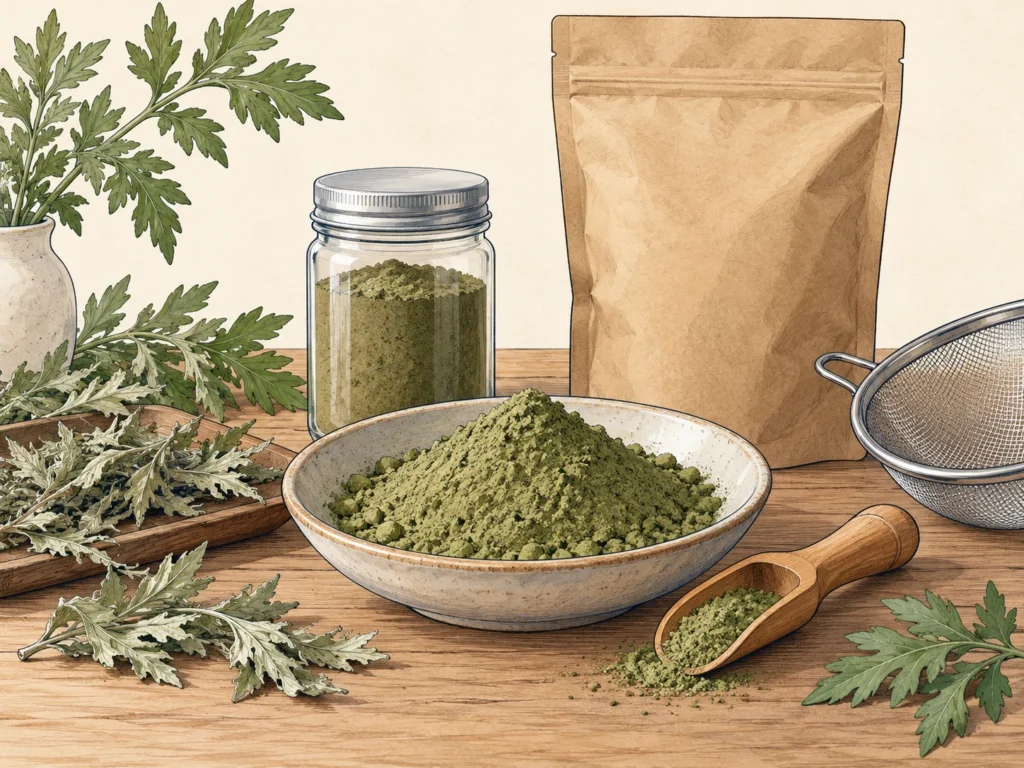
Mugwort powder can mean milled dried plant material, a powdered extract or a prepared blend. Before buying, confirm the botanical identity, plant part, processing method, ingredients, particle specification, intended use and batch documentation. A photograph and the word “fine” do not provide enough information to compare two powders.
The same search can lead to powders sold for different applications. A bag intended as a raw formulation ingredient is not automatically equivalent to a finished skincare product or a product prepared for another use.
This guide focuses on identifying the material, comparing samples and writing a useful purchasing specification. For the wider sourcing process, GCB also has a separate mugwort raw-material and OEM sourcing guide.
What exactly is mugwort powder?
In a straightforward leaf-powder product, dried plant material is milled into smaller particles. A powdered extract involves extraction and subsequent processing, while a prepared blend may combine a mugwort ingredient with other materials.
Those differences affect the specification. Do not assume a product described as “extract powder” is simply a finer version of ground leaves. Ask the supplier to identify the actual material and explain the process used to make it.
| Description | What it may refer to | What to confirm |
|---|---|---|
| Mugwort leaf powder | Dried leaves milled into powder | Botanical identity, leaf content, processing and particle specification |
| Mugwort herb powder | A milled herb product; included plant parts can vary | Leaves, stems or other material included in the supplied product |
| Mugwort extract powder | A powdered preparation made through extraction and further processing | Starting material, extraction information, carriers and the meaning of any concentration claim |
| Prepared mugwort powder blend | A mixture containing mugwort and additional ingredients | Complete composition and suitability for the intended application |
Confirm the species and plant part
“Mugwort” is a common name used for different Artemisia plants. Commercial products can identify species such as Artemisia vulgaris or Artemisia argyi. Use the supplier's botanical name and supporting identity information instead of treating every mugwort listing as the same ingredient.
Also confirm the plant part. A leaf-focused specification and a powder containing substantial stem material are different purchasing requirements. Grinding makes the original material harder to assess visually, which increases the importance of clear descriptions and traceable records.
Ask how origin is recorded. The location of a trading office does not necessarily identify where the plant was grown or processed. If a particular origin is important to your product, state that requirement and ask what evidence the supplier can provide.
What does “fine” or “ultrafine” actually mean?
Those words need a measurable specification. Ask for the stated particle size or sieve requirement, the method used and the accepted proportion of material meeting that requirement. Keep the unit and test method with the result.
A mesh description, a particle-size range and a visual claim of smoothness are not the same information. Do not compare numbers without confirming what was measured. A single nominal figure can also hide differences in the distribution of coarse and fine particles.
For a formulation project, have the formulator evaluate the sample in the intended process. Appearance in a dry dish does not establish texture, dispersion or performance in the final product. Milling a leaf more finely does not automatically turn it into a soluble extract.
How should you compare color, smell and texture?
Compare samples under consistent conditions. Label them, use similar containers and lighting, and record what you observe. Note obvious differences in color, odor, lumps, loose fibers or coarse particles.
Natural materials can vary, but “natural variation” should not become an unlimited explanation for a changed order. Agree the acceptable range and which differences need investigation. A brighter green color is not, by itself, evidence of greater purity or better quality.
Ask about added ingredients, treatments and storage conditions. Do not rely on a photograph to establish identity or composition. Visual and odor checks help identify questions; they cannot confirm all quality characteristics.
What specifications should a buyer request?
Begin with the intended application and destination. The supplier should know whether the material is being considered for professional formulation, an external-use product or another defined application. Avoid treating a broad grade description as a complete specification.
| Item | Information to request |
|---|---|
| Identity | Botanical name, plant part, source information and product code |
| Composition and process | Milled herb, extract or blend; any carriers, additives or relevant treatments |
| Physical characteristics | Particle specification, appearance, odor and agreed methods |
| Quality criteria | Agreed moisture, identity, microbiological and relevant contaminant criteria for the application |
| Batch information | Lot number, relevant dates and analysis or other supporting records |
| Packaging and storage | Inner liner, closure, pack weight, storage instructions and supported shelf-life information |
There is no single universal moisture limit, particle size or document set that fits every mugwort powder project. Set the requirements with the relevant formulator, buyer or qualified reviewer for the product and destination, then obtain the supplier's written agreement.
Which quality documents are useful?
A product specification describes the agreed material and acceptance criteria. A batch analysis record or certificate of analysis, often called a COA, records results for an identified lot. Check that the product, batch, methods and results correspond to what is being supplied.
Where separate reports are needed, establish the sample identity, date and scope. An old report for another batch should not silently become evidence for the current shipment. A supplier brochure is useful background, but it is not a substitute for the agreed order specification.
A factory visit can help assess processing, storage, traceability and working practices. It does not establish chemical composition or every microbiological characteristic by visual inspection. GCB can help clarify what information is available and coordinate the agreed checks.
How should samples be approved?
Request a representative sample of the proposed material and label it with the supplier, product code, lot and receipt date. Ask whether it comes from a stock batch or a separate sample preparation.
Keep the sample sealed as appropriate and retain its documents. Have the intended user evaluate it against the application. For a formulation ingredient, that may include a controlled comparison within the intended formulation process rather than judging the dry powder alone.
Record the approved version and acceptance points before ordering. Agree how production lots will be compared, what changes require approval and how nonconforming material will be handled.
Compare quotations on the same basis
Send each candidate the same brief. A price difference may reflect another plant part, process, particle requirement, pack size or quality scope. Ask suppliers to identify exceptions rather than assuming a lower price covers the same product.
Separate the material quantity from private label packaging minimums. For a first order, standard bulk packing and custom retail pouches may involve different costs and preparation times. Freight and destination handling also affect the cost of receiving the usable material.
If you want finished retail products, clarify that this requires more than buying powder in a printed pouch. The intended use, finished-product requirements, instructions and packing must be defined. GCB can help coordinate samples and MOQ discussions before a larger commitment.
Frequently asked questions
Is mugwort leaf powder the same as mugwort extract powder?
No. Leaf powder is milled plant material. An extract powder is a different preparation. Confirm the process, composition and specification rather than assuming the names are interchangeable.
Which mugwort species should I buy?
That depends on the intended product and specification. Ask for the exact botanical name and identity information, and confirm suitability with the relevant product specialist.
Is finer mugwort powder always better?
No. The useful particle specification depends on the application. Compare material in the intended process and obtain a measurable specification instead of relying on “ultrafine.”
Can color show whether mugwort powder is pure?
No. Color can help compare samples, but it does not establish identity, additives or purity. Use composition information, traceability and relevant assessment alongside visual checks.
Should the COA match the supplied batch?
Where batch analysis is required, the record should identify the relevant product and lot. Check the methods, acceptance criteria and results rather than accepting a generic document without context.
Can GCB help with small quantities and custom pouches?
Yes, we can discuss supplier options, samples and packaging coordination. Product and printed-packaging minimums are confirmed separately for the actual project.
Related guidance: OEM & Private Label · Samples & MOQ · Pricing & Payment
Updated October 18, 2026.
About Global China Bridge
Global China Bridge is a China-based sourcing and product-development service company helping overseas entrepreneurs, small brands, retailers and other small businesses work with Chinese manufacturers. We support supplier searches, factory verification, samples, OEM and private label packaging, production follow-up, quality checks and shipping coordination.
Planning a mugwort powder project? Tell us your target country, product requirements, approximate quantity and packaging idea. Small orders are welcome to discuss. We start with a free conversation, then agree a clear scope and fee for any work.