
For a small business, finding a product manufacturer in China starts with a realistic first order. Define the product customers need, the quantity you can support, and the customization that matters. Then look for manufacturers whose production methods and order requirements fit that brief.
You do not need the biggest factory or an ambitious range on day one. You need a workable product, a clear purchasing arrangement, and enough budget left to reach your customers.
Global China Bridge helps entrepreneurs and small businesses work through supplier questions, samples, and first-order options in China. Tell Bryan what you are hoping to build and what is making the next step difficult.
Discuss your first product with Bryan
A small order can represent a very large commitment.
For a factory, your enquiry may be one of many. For you, it may be the money saved for a new business, a product your existing customers have requested, or the first step toward your own brand.
You cannot afford to keep purchasing samples that miss the brief. You may not have someone dedicated to comparing quotations or following up on production. And you need to know the cost before deciding whether the idea makes commercial sense.
That is why the search should begin with the business you want to build. A supplier’s attractive catalogue is useful only if its products and terms support your plan.
What should your first order help you learn?
Perhaps you need to test whether customers like the size, construction, or finish. Perhaps they already buy a similar product from you and you want a better version. Those are different starting points.
If demand is still uncertain, committing to many variants may increase spending before you understand which ones customers want. If the product already has customers, your priority may be matching performance while improving supply consistency.
Tell us what is known and what needs testing. That helps distinguish features essential to the product from choices that can wait for a later order.
Choose a starting route your business can support.
| Starting route | What you would explore | What needs confirmation |
|---|---|---|
| Existing product | A manufacturer’s available design, with limited or no changes. | Availability, quantities, specifications, checks, and packaging. |
| Existing design with your branding | A logo, label, sleeve, or retail packaging suited to your launch. | Separate branding minimums, artwork, setup charges, and sample scope. |
| Modified design | Changes to dimensions, components, materials, or construction. | Technical feasibility, development costs, new samples, and production requirements. |
| New design | Development and possibly new tooling. | Development stages, ownership arrangements, testing, cost, and timing. |
A new design may be exactly what your customers need. But do not assume it is required merely to create a brand. An existing design with carefully chosen branding may offer a more manageable first step when it meets the product requirements.
Why “low MOQ” may still exceed your budget
The minimum order quantity may apply per colour, size, model, or material batch. Packaging and components can have their own minimums.
A factory agreeing to 200 finished products may still require you to purchase more printed boxes than you can use immediately. A request for four colours may create four separate production minimums.
We can help clarify where those requirements come from and whether alternatives are possible. Available materials, fewer variants, standard components, or simpler packaging may change the economics.
Some constraints cannot be negotiated away without compromising the product. If a sensible first batch is not feasible, finding that out early is better than committing more cash to satisfy a headline MOQ.
Compare the cost of getting ready to sell.
Your unit price is one part of the calculation. Include sample and development charges, branding, packaging, relevant tests or inspections, freight, and applicable destination costs. Confirm logistics and import assumptions with appropriate providers.
You also need funds for selling the product: photography, your sales channel, customer acquisition, and handling returns or replacements. Spending the entire launch budget on stock can leave too little to put it in front of buyers.
A simple working sheet should separate one-time costs, costs per unit, delivery estimates, and uncertain items. When comparing quotations, use the same specifications and quantities. A lower price based on thinner material or stock packaging is a different offer.
We can help clarify supplier-side assumptions so you can judge the purchase against your business plan. Your customer demand, selling price, and route to market still need your own testing.
For example, three pouch sizes may be too much for a first launch.
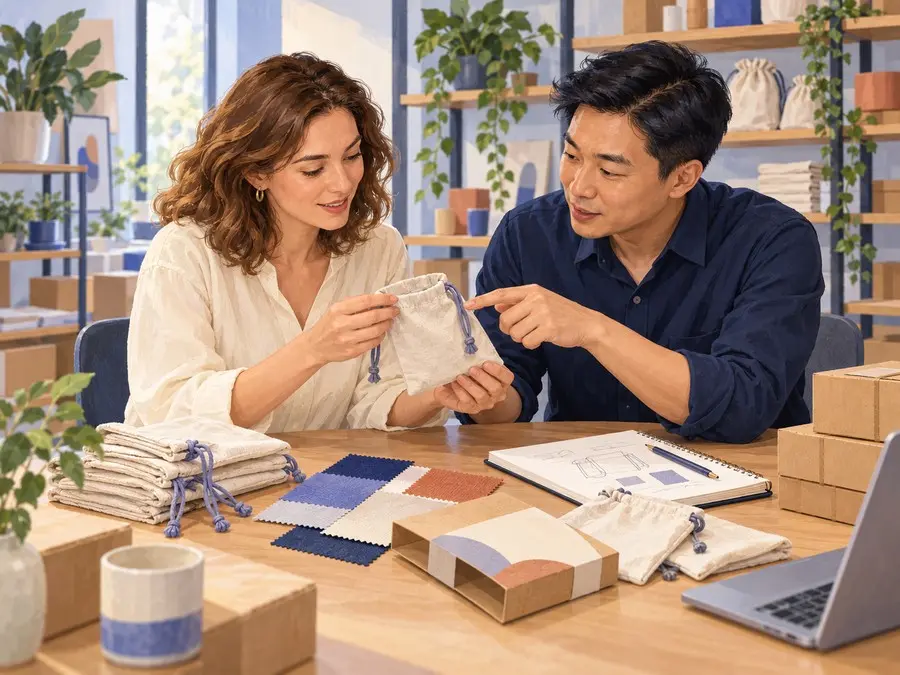
Imagine a small shop wants 150 branded fabric pouches. The initial idea includes three sizes, three colours, a woven label, and a printed box. Several manufacturers respond, but the quotations are higher than expected and the minimums are unclear.
The combination creates nine variants before any packaging choices are considered. Each may involve a separate quantity or material constraint. The buyer is trying to test demand, but the proposed order already resembles a much wider range.
With Global China Bridge, we could first clarify the purpose of the product. What will customers put inside? Which dimensions are essential? Would one size and one available fabric colour answer the first sales question?
With the buyer’s agreement, we could discuss that narrower brief with relevant manufacturers, clarify the logo options, and compare packaging alternatives. A sample could then be reviewed for stitching, dimensions, closure, and the agreed fabric.
A workable option might emerge. Alternatively, the revised costs might show that the expected retail price or order size needs reconsideration. Either result gives the buyer useful information before purchasing a full batch.
The aim is a first version that helps the business learn without giving up the qualities customers need.
What a useful manufacturer conversation should establish
Before spending on a sample, get the important assumptions into the discussion:
- Product fit: relevant processes and experience, with the proposed production location identified.
- Order fit: quantities per variant and separate component or packaging minimums.
- Sample purpose: whether the sample demonstrates stock workmanship, your branding, or the intended production specification.
- Price scope: included materials, packaging, setup charges, and delivery terms.
- Timing: what must be approved or available before sampling and production begin.
- Checking and changes: how requirements are recorded, changes authorized, and relevant checks arranged.
If a product needs specialist testing or destination-market compliance work, discuss that early. A supplier’s experience selling overseas is not confirmation that your particular version meets every applicable requirement.
How China Bridge helps a small business move forward
You may have limited time and no purchasing team in China. We can discuss the work that would make your next decision easier.
That could begin with clarifying your product brief, researching relevant candidates, following up on unanswered questions, comparing quotations, or coordinating a sample revision. The useful scope depends on the project and the information suppliers can provide.
You should understand what is proposed, what you will receive, and the cost before paid work begins. Samples, factory visits, specialist testing, independent inspections, and logistics require their own confirmed arrangements where applicable.
We want the work to reduce uncertainty you would otherwise spend time and money resolving. Repeated enquiries and unsuitable samples are costs too, even when no one calls them a service fee.
Start small enough to manage—but clear enough to evaluate.
A small order still needs a defined product version and agreed terms. Keep the approved sample identifiable, record relevant specifications, and establish what happens if the supplier proposes a change.
After delivery, review product consistency, customer feedback, communication, and the actual costs. Those results can help you decide whether to repeat the order, improve the product, or expand the range.
A larger purchase should follow evidence that the route works for your business. It does not need to be the price of getting started.
Your first step deserves serious attention.
I’m Bryan, the founder of Global China Bridge, based in Beijing. I started this business because China’s products and manufacturing capabilities should be useful to small business owners as well as large companies with purchasing teams.
A small order may carry a great deal of hope. I want to understand what you are trying to achieve before discussing suppliers. Helping your business progress gives ours a foundation to grow; a task you entrust to us deserves careful attention.
Meet Bryan
Read why I started Global China Bridge and who I want to work with.
Meet Bryan and read our story →Sourcing Stories
Explore the practical questions and decisions involved in other sourcing projects.
Explore our sourcing stories →You can start with an idea and one question.
Tell me what you want to sell, who it is for, and roughly how you want to begin. A reference image, approximate quantity, or budget range can help. It is fine to say which details are undecided.
The introductory conversation is free, with no obligation to proceed. If there is a useful way to help, we can agree on a small task and its fee before considering a wider commitment. Supplier and third-party charges are confirmed separately where applicable.
You do not need to promise a large order. Begin with the decision that matters now.
Tell Bryan about your small business
Prefer email? Write to service@globalchinabridge.com. A general outline is enough; detailed confidential designs can wait until we discuss how to share them.
Questions small business owners ask
Can I contact you before starting my company?
Yes. We can begin with your idea and questions. Contracting, payment, and import arrangements for any later order need clarification before you commit.
Do manufacturers accept small first orders?
Some projects can support them; others cannot. Feasibility depends on materials, processes, customization, and quantities per variant. We can explore suitable options.
Do I need a fully custom product to start a brand?
No. An existing design with appropriate branding may fit your customers. A new design makes sense when its differences are important enough to justify the development work.
What budget do I need?
There is no universal figure. Define the product, first quantity, customization, destination, and necessary checks, then compare complete costs against the funds available for your launch.
Can you help with a product I already sell?
We can discuss the improvement or supply problem you want to address and whether a defined search or coordination task would help.
Can we begin with one limited task?
Yes. We can discuss a specific question, expected output, and fee before deciding whether broader support is useful.
Planning the wider search? Read how to find a manufacturer in China.